
Propane Garage Heater: Sizing, Runtime, and Safety
Propane garage heater guide: BTU sizing per square foot, how long a 20 lb tank lasts, vented vs ventless safety, and when propane beats electric or natural gas.
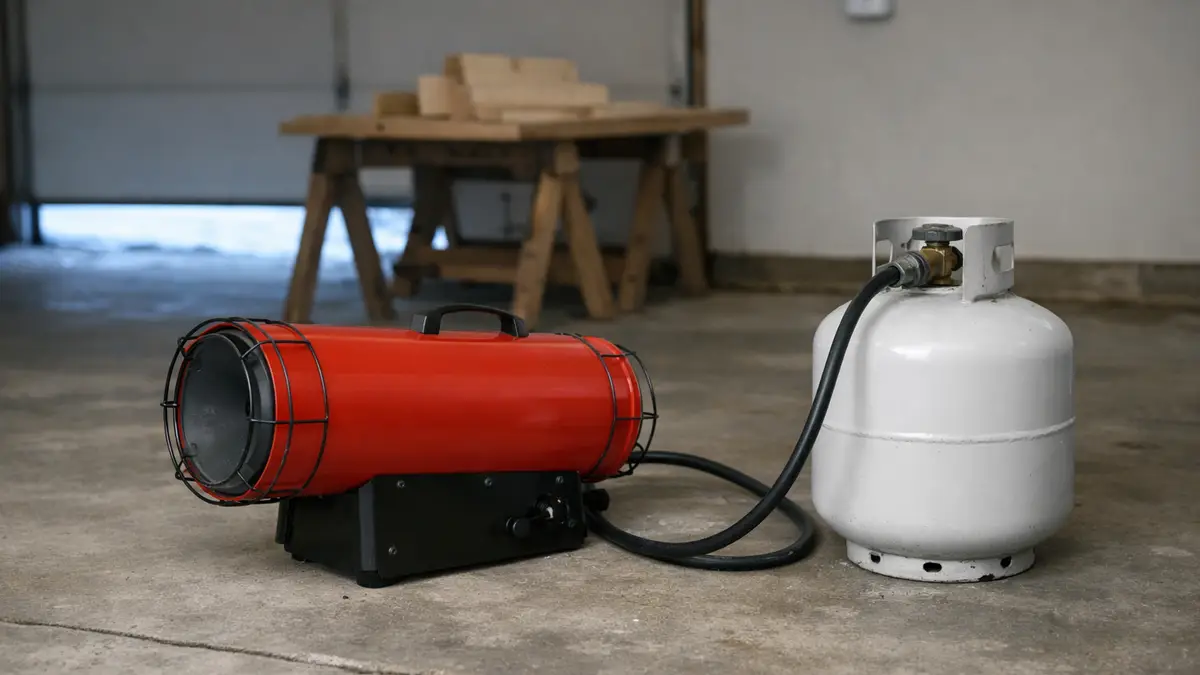
A propane garage heater burns bottled gas to heat a garage that has no natural-gas line and no spare 240V circuit, which describes a lot of detached and older garages. Propane delivers a large amount of heat quickly from a portable unit, but the two things buyers underestimate are how fast a tank empties and what a ventless model demands for safe air. This guide covers sizing, runtime, cost and the ventilation rules.
What size propane heater does a garage need?
Size it at about 30 to 45 BTU per square foot, adjusted for insulation. An insulated garage sits at the low end; a cold, drafty one needs the high end. Multiply your floor area by the rate to get the BTU/h input you need:
| Garage | Area | Insulated, about 30 BTU/sq ft | Cold or drafty, about 45 BTU/sq ft |
|---|---|---|---|
| 1-car, 12 x 22 ft | 264 sq ft | 7,900 BTU/h | 11,900 BTU/h |
| 2-car, 20 x 20 ft | 400 sq ft | 12,000 BTU/h | 18,000 BTU/h |
| 2-car, 24 x 24 ft | 576 sq ft | 17,300 BTU/h | 25,900 BTU/h |
| 3-car, 32 x 24 ft | 768 sq ft | 23,000 BTU/h | 34,600 BTU/h |
Insulating first drops the number you need, which is why our garage insulation and garage door insulation kit guides pay back fast. Garage sizes are from our garage dimensions reference.
How long does a propane tank last on a garage heater?
Longer than most expect at low output, and surprisingly short at full blast. Propane holds about 91,500 BTU per gallon, and a standard 20 lb barbecue tank holds about 4.7 gallons, or roughly 430,000 usable BTU. Divide that by the heater’s hourly input to get runtime:
| Heater output | 1 lb cylinder (about 21,500 BTU) | 20 lb tank (about 430,000 BTU) | 100 lb tank (about 2.15M BTU) |
|---|---|---|---|
| 9,000 BTU/h | About 2.4 hr | About 48 hr | About 239 hr |
| 18,000 BTU/h | About 1.2 hr | About 24 hr | About 119 hr |
| 30,000 BTU/h | About 0.7 hr | About 14 hr | About 72 hr |
| 60,000 BTU/h | About 0.4 hr | About 7 hr | About 36 hr |
The lesson is to size a tank to how long you heat. A portable radiant heater on a 20 lb tank runs a work session fine; a 60,000 BTU/h forced-air torpedo heater for all-day warmth wants a 100 lb tank or a refill on hand.
What does a propane garage heater cost to run?
Divide the BTU/h by 91,500 to get gallons per hour, then multiply by your local propane price. A 30,000 BTU/h heater burns about 0.33 gallons per hour, so at a propane price of, say, $3.50 per gallon it costs roughly $1.15 per hour of full-output heat. A 60,000 BTU/h unit at the same price costs about $2.30 per hour.
Compare that to electric on your own bills: a 5,000 W electric heater uses 5 kWh per hour, so multiply by your kWh rate. Where electricity is cheap, electric can undercut propane; where propane is cheap and you have no 240V circuit, propane wins. Our best garage heater guide runs the same cost math across fuels.
Vented, ventless, or portable: which propane heater?
Pick by how the garage handles combustion gases. The three families differ in how, and whether, they exhaust:
- Vented unit heater (for example a Modine Hot Dawg or Mr. Heater Big Maxx on a propane conversion kit): mounted and ducted to the outside, so combustion gases leave the garage. The cleanest air, but it needs a vent run and a gas or tank connection, which is installed work.
- Ventless portable forced-air (torpedo) heater: high output, 30,000 to 60,000 BTU/h, but it dumps all its combustion products and moisture into the garage and needs strong ventilation. For quick heat in a well-ventilated space, not a sealed one.
- Ventless portable radiant (for example the Mr. Heater Big Buddy, 4,000 to 18,000 BTU/h): indoor-safe designs include an oxygen-depletion sensor and a fixed fresh-air requirement. Good for spot heat at a workbench.
A vented unit is the set-and-forget choice if you can install it; a portable radiant heater is the low-cost choice if you heat a corner for a few hours.
How do you use a ventless propane heater safely?
Run only an indoor-rated model, with its required fresh-air opening and a carbon monoxide alarm, and never while you sleep. A ventless propane heater releases its combustion gases, including carbon monoxide and water vapor, into the garage, so safe use is non-negotiable:
- Fresh-air opening. Follow the manual. The Mr. Heater Big Buddy manual, for example, requires an opening of about 18 square inches to outside air. That opening is not optional.
- Carbon monoxide alarm. Run one in the garage and in any living space it shares a wall with.
- Oxygen-depletion sensor (ODS). Use only models that have one; it shuts the heater off if oxygen drops.
- Never unattended or asleep. Turn it off when you leave, and never run it overnight.
- Moisture. Ventless propane adds water vapor, which can raise humidity and rust tools; pair it with ventilation.
Because combustion air matters, read our garage ventilation guide alongside this one. And never run a car engine in the garage for heat or any other reason.
How does propane compare to natural gas in a garage?
Propane and natural gas heat a garage the same way, but they differ in supply and energy density. Natural gas comes from a utility line at a low cost per BTU where it is available, and never needs refilling, but running a line to a detached garage can be expensive. Propane comes in tanks you refill, costs more per BTU in most areas, but needs no utility connection, which is why it wins for detached and off-grid garages.
Many unit heaters, such as the Mr. Heater Big Maxx and Modine Hot Dawg lines, run on either fuel with a conversion kit, so the heater is often the same and only the supply differs. If a gas line reaches the garage, natural gas is usually the cheaper long-run choice; if it does not, propane avoids the trenching and the meter.
How do you store propane tanks safely?
Store propane tanks upright, outdoors, and away from the living space and any ignition source. A leaking tank releases gas that is heavier than air and pools low, so a tank is never stored in a basement or a closed living area. Keep spare 20 or 100 lb tanks outside the garage where you can, shaded from direct heat, and check the hose and regulator for cracks before each use.
When a tank is connected to a heater indoors, follow the heater manual on tank placement and the fresh-air opening, and shut the tank valve, not just the heater, when you finish for the day.
Who should not use a propane garage heater?
Anyone who wants vent-free, moisture-free heat in a sealed garage, or who can easily run a gas line or 240V circuit. If you have the power, a hardwired electric heater gives clean heat with no tank, no combustion gases and no refills, as our best garage heater guide covers. Propane earns its place where there is no gas line and no spare electrical capacity, and where you accept the ventilation and refill routine.
Where do these numbers come from?
We did not test these heaters; the figures are calculated from propane’s energy content and the makers’ published ratings. Propane energy (about 91,500 BTU per gallon) and a 20 lb tank’s capacity (about 4.7 gallons) are standard values; runtime divides usable tank energy by each heater’s input rating. The BTU-per-square-foot ranges follow common garage heating practice. The Big Buddy fresh-air requirement is from Mr. Heater’s manual. Confirm the manual for your exact model, and have any gas or tank line work done to local code.
Frequently asked questions
Quick answers to what readers ask us most
What size propane heater do I need for a garage?
About 30 to 45 BTU per square foot. A 400 sq ft two-car garage wants roughly 12,000 to 18,000 BTU/h if insulated and up to 36,000 BTU/h if cold and drafty. A portable radiant heater like the Mr. Heater Big Buddy covers a corner at 4,000 to 18,000 BTU/h; a forced-air unit heats a whole bay.
How long does a 20 lb propane tank last on a garage heater?
A 20 lb tank holds about 430,000 BTU of usable energy. A 30,000 BTU/h heater burns through it in roughly 14 hours at low and under 7 hours at full output. A thirsty 60,000 BTU/h forced-air torpedo heater empties a 20 lb tank in about 7 hours, so plan a 100 lb tank for all-day use.
Is a propane heater safe to use in a closed garage?
Only a ventless model rated for indoor use, and only with its required fresh-air opening and a carbon monoxide alarm. Ventless propane heaters release combustion gases, including water vapor and carbon monoxide, into the room, so they need an oxygen-depletion sensor, a fixed air opening per the manual, and never run while you sleep.
Is propane or electric better for heating a garage?
Propane wins when there is no 240V circuit or gas line, and it delivers a lot of heat fast from a portable unit. Electric wins for clean, vent-free, set-and-forget heat where the power exists. Propane costs depend on local tank prices; electric costs depend on your kWh rate, so compare both on your own bills.