
Garage Cabinets: Steel vs Plastic vs Wood, Best Systems
Garage cabinets compared: welded steel, flat-pack steel, resin and wood, with steel gauge explained, per-shelf ratings, depth vs parking room and 2026 prices.
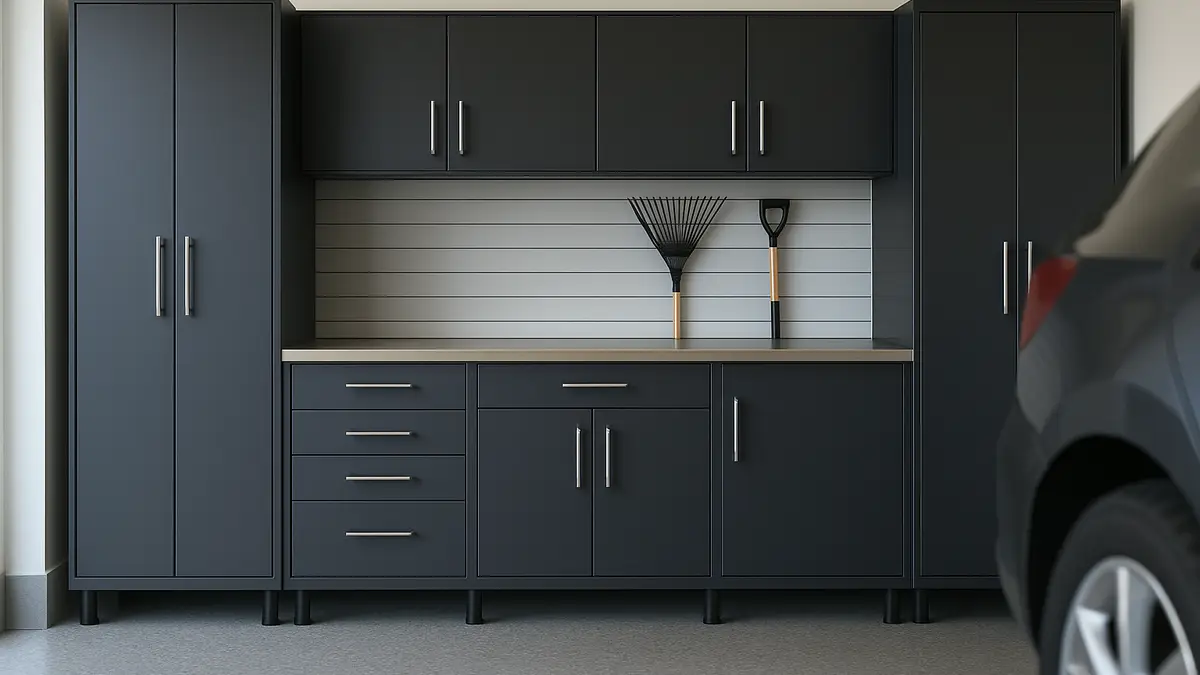
Garage cabinets are enclosed storage units built for an unheated, sometimes damp room with a concrete floor: tall lockers, base cabinets with a worktop, wall cabinets, and often a slatwall rail system above them. The material decides how they cope with moisture and weight, and the maker’s per-shelf rating tells you more than the marketing does. All prices are from maker and retailer pages in October 2026.
Which garage cabinets should you buy?
Buy by the weight you will store and how damp the garage gets. The table uses each maker’s printed specifications.
| Cabinet line | Material | Depth | Load rating | Example price, Oct 2026 |
|---|---|---|---|---|
| NewAge Pro 3.0 | Fully welded 18-gauge steel frames and doors | 24 in. | Lockers and floor cabinets up to 1,000 lb | 6-piece set $2,369.99 (Inventive Garage) |
| Gladiator Premier pre-assembled | Welded steel, tread-plate doors | 24 in. (84 in. tall cabinet) | 2,000 lb per unit, 400 lb per shelf (84 in. cabinet) | 84 in. tall cabinet $1,299.99 (maker) |
| NewAge Bold 3.0 | Fully welded 24-gauge steel frames | 18 in. | Locker 800 lb total, 150 lb per shelf; base 600 lb, 200 lb per shelf | 36 in. locker about $628 to $700 |
| Gladiator ready-to-assemble | Steel, flat-packed | 18 in. | Large GearBox 450 lb per unit, 75 lb per shelf | Large GearBox $429.99 list ($369.79 on sale) |
| Keter utility storage cabinet | Resin | 17.7 in. | 55 lb per shelf | $204.99 (maker) |
Gladiator does not print a steel gauge on its product pages, so compare its cabinets by the load ratings instead.
Which is better for a garage: steel, plastic or wood?
Steel is the best all-round garage cabinet material, resin is best for damp garages and light loads, and wood or melamine is best only in a dry, conditioned garage. The trade-offs:
| Steel | Plastic (resin) | Wood, MDF or melamine | |
|---|---|---|---|
| Moisture | Powder coat resists it; scratches can rust | Does not rust or swell | Particleboard and MDF swell where edges get wet |
| Load per shelf | 75 to 400 lb in this guide | 55 lb (Keter) | Depends on build; long shelves sag under weight |
| Dents and impacts | Thin gauges dent; thick gauges do not | Flexes, scuffs | Chips at edges |
| Assembly | Welded units arrive built; RTA bolts together | About 25 minutes, one person (Keter) | Usually professionally installed |
| Best for | Tools, fluids, heavy bins | Garden and pool supplies, light bins | A finished, heated garage that doubles as a room |
Whatever the material, keep the boxes off wet concrete. Steel cabinets ship with leveling legs for that reason, and a coated or sealed floor helps too (see our garage floor coating options).
What does steel gauge mean for garage cabinets?
Steel gauge is a thickness scale where a lower number means thicker steel. On the standard sheet steel scale, 18 gauge is about 0.048 in. (1.2 mm) thick and 24 gauge about 0.024 in. (0.6 mm), so an 18-gauge cabinet uses steel twice as thick as a 24-gauge one.
That difference shows up in three places:
- Dents. A thin door panel dents when a bike pedal or a car door hits it; a thick one does not.
- Shelf sag. Thicker shelves and frames carry more weight without bowing, which is why the 18-gauge line carries higher ratings.
- Weight and price. Thicker steel costs more to buy and ship. A 24-gauge welded cabinet is still far stiffer than most flat-packed units, because welding holds the box square.
Gauge alone does not settle it. Compare the load per shelf, whether the frame is welded or bolted, and whether the doors are single or double-wall.
Which cabinet system is worth the money?
Pick the cheapest line whose ratings cover what you actually store:
Heavy tools, daily workshop use: NewAge Pro 3.0. 18-gauge frames and doors, fully welded, 24 in. deep, with lockers and floor cabinets rated up to 1,000 lb and worktops in bamboo or stainless steel. The 6-piece set with a utility cart was $2,369.99 at Inventive Garage, an authorized seller, in October 2026. Not for a shallow garage where 24 in. of depth costs a parking spot.
Heavy, bulky storage: Gladiator Premier. The pre-assembled 84 in. tall cabinet (36 x 84 x 24 in.) is rated at 2,000 lb per unit and 400 lb per shelf, with four full-width shelves and locking doors, for $1,299.99. Not for tight budgets.
Best value: NewAge Bold 3.0. Welded 24-gauge frames, 18 in. deep, lockers rated at 800 lb with 150 lb shelves, and a limited lifetime warranty. A 36 in. multi-use locker sold for about $628 to $700 at Garage Cabinets Online.
Lowest-cost steel: Gladiator ready-to-assemble. The Large GearBox (36 x 72 x 18 in.) holds 450 lb with 75 lb per shelf and three full-width shelves. Not for heavy power tools on every shelf.
Damp garages and light items: Keter. The resin utility storage cabinet is 70.5 in. tall, holds 55 lb per shelf on five shelves, locks with a padlock and carries a 2-year limited warranty.
How much parking room do cabinets take?
A run of cabinets takes its full depth from the garage, and the car door needs room to open beside it. On the back wall, an 18 in. run on a 24 ft deep garage leaves 22.5 ft of floor; a 24 in. run leaves 22 ft. On a 20 ft deep garage, the same runs leave 18.5 ft and 18 ft.
| Garage depth | No cabinets | 18 in. cabinets | 24 in. cabinets |
|---|---|---|---|
| 20 ft | 20 ft | 18.5 ft | 18 ft |
| 22 ft | 22 ft | 20.5 ft | 20 ft |
| 24 ft | 24 ft | 22.5 ft | 22 ft |
Measure your longest vehicle bumper to bumper and add room to walk past it before choosing a depth. Typical 1-, 2- and 3-car garage sizes are in our garage dimensions guide. Wall cabinets hung high enough to clear the hood of the car parked in front of them keep the floor clear and work in garages too shallow for floor cabinets.
Do you need slatwall as well as cabinets?
Slatwall is worth adding for tools you grab every day, since hooks and baskets keep them visible and off the bench. Gladiator’s 8 ft GearWall panels are 96 x 12 x 0.75 in., hold 50 lb per sq ft by the maker’s rating, and sold for about $129.99 per 2-pack (16 sq ft, roughly $8 per sq ft) in October 2026. Slatwall, pegboard and track rails are compared by load rating in our garage wall organizer guide.
Plan the wall in bands: base cabinets and a worktop at the bottom, slatwall at reach height above the worktop, and wall cabinets or open shelving above that. Bulky seasonal items that you touch twice a year belong on a ceiling rack instead; our overhead garage storage guide covers racks, weight limits and where the door and opener get in the way.
How should garage cabinets be installed?
Install tall and wall cabinets into wall studs, level them on the floor, and keep them clear of the door tracks and water heater. NewAge’s installation guidance recommends two people for lifting and securing each unit to wall studs to prevent tipping; Gladiator sells a $39.99 wall bracket kit for its freestanding units.
Three checks before you order:
- Stud layout and wall type. Wall cabinets need solid framing behind them. Concrete block walls need masonry anchors rated for the load.
- Floor slope. Garage floors slope toward the door; leveling legs take up the difference.
- Outlets and switches. Note where they sit so a cabinet does not bury one. Some systems have cable pass-throughs for a charger or a lit worktop.
Who should skip a cabinet system?
Skip a full cabinet system if you rent, if the garage is too shallow to park and still open a car door, or if most of what you store is bulky and light. Freestanding resin cabinets or open steel shelving move with you and cost a fraction of a welded set. In a damp, unheated garage, avoid melamine and particleboard, and keep any cabinet off the bare floor. If the air stays damp, our garage dehumidifier guide covers units that run in a cold garage.
Where do these numbers come from?
We did not load-test cabinets; ratings are the makers’ own. NewAge Bold 3.0 ratings, gauge and depth: newageproducts.com, October 2026. NewAge Pro 3.0 gauge: newageproducts.com; capacities, set contents and price: Inventive Garage product page, October 2026. Bold 3.0 locker price: Garage Cabinets Online, October 2026. Gladiator Premier 84 in. cabinet and Large GearBox ratings and prices, and the wall bracket kit: gladiatorgarageworks.com, October 2026. GearWall panel size and rating: gladiatorgarageworks.com; 2-pack price from retailer listings, October 2026. Keter utility storage cabinet: keter.com, October 2026. Sheet steel thickness: the standard Manufacturers’ Standard Gauge for sheet steel (18 gauge 0.0478 in., 24 gauge 0.0239 in.).
Frequently asked questions
Quick answers to what readers ask us most
What are the best garage cabinets?
For heavy tools and daily use, fully welded steel with high shelf ratings, such as NewAge Pro 3.0 or Gladiator Premier. For a budget, 24-gauge NewAge Bold 3.0 or a ready-to-assemble Gladiator GearBox. For light items in a damp garage, a resin cabinet like Keter's that will not rust.
Is 18-gauge or 24-gauge steel better for garage cabinets?
18-gauge is better: lower gauge numbers mean thicker steel. Standard sheet steel at 18 gauge is about 0.048 in. thick and 24 gauge about 0.024 in., so 18-gauge is twice as thick and resists dents and sagging far better. It also costs and weighs more.
How deep should garage cabinets be?
Most run 18 in. or 24 in. deep. An 18 in. run on the back wall of a 24 ft garage leaves 22.5 ft of floor; a 24 in. run leaves 22 ft. In a shallow 20 ft garage, 18 in. cabinets or wall-only cabinets usually keep parking workable.
Are plastic garage cabinets any good?
They are good for light, bulky items and damp garages because resin does not rust or swell. They hold less: Keter rates its utility storage cabinet at 55 lb per shelf, against 75 to 400 lb for the steel cabinets compared here.
Should garage cabinets be anchored to the wall?
Yes. Tall cabinets can tip when doors and drawers open with weight inside. NewAge's installation guidance calls for securing units to wall studs, and Gladiator sells a wall bracket kit for its freestanding cabinets. Use studs, not drywall anchors.