
Garage Ventilation: How to Move the Air and Fumes Out
How to ventilate a garage: the CFM a target air-change rate needs, why an exhaust fan fails without an intake vent, passive vs active options, and fume safety.
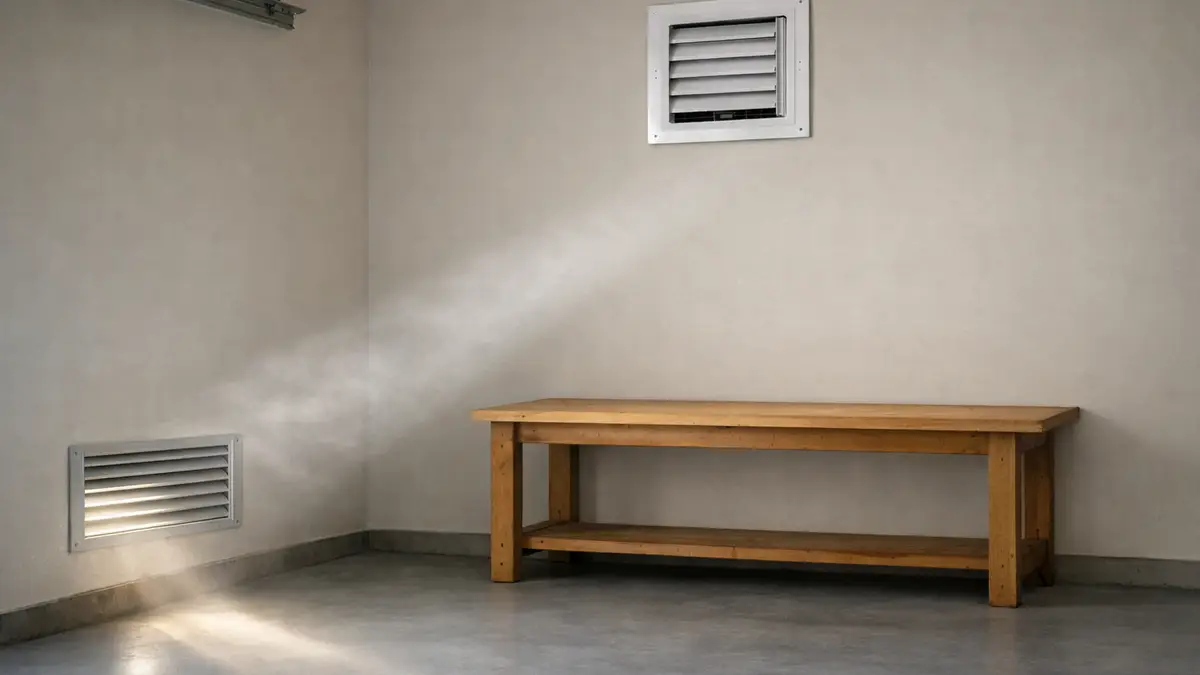
Garage ventilation means moving stale, humid or fume-laden air out and fresh air in, and it only works when both halves happen. The mistake most homeowners make is mounting an exhaust fan and expecting results without giving the air anywhere to come from. This guide sizes ventilation in CFM from your garage volume, explains the intake half, and separates passive from active options by the problem each one solves.
How do you ventilate a garage?
Pair an exhaust with an intake so air flows through the space. Air pushed out by a fan or rising through a high vent has to be replaced by fresh air entering somewhere else, ideally low and on the opposite side, so the incoming air sweeps across the room. Set up only one half and the airflow stalls.
The three jobs ventilation does are different, and the right fix depends on which you have:
| Problem | What it is | Best fix |
|---|---|---|
| Fumes | Paint, solvent, exhaust, VOCs | Active exhaust fan plus intake, high CFM |
| Heat | Summer buildup under the roof | High exhaust vent or fan, low intake |
| Humidity | Damp air, rust, mildew | Air exchange plus a dehumidifier |
What size exhaust fan does a garage need?
Size it from the garage volume and the air-change rate you want. The formula is volume (length times width times height) times air changes per hour (ACH), divided by 60, which gives the CFM the fan must move. For fumes, aim for 6 to 8 or more air changes per hour; for general freshening, 4 to 6 is enough.
| Garage | Volume (at 9 ft) | 4 ACH | 8 ACH |
|---|---|---|---|
| 1-car, 12 x 22 ft | About 2,376 cu ft | 158 CFM | 317 CFM |
| 2-car, 20 x 20 ft | About 3,600 cu ft | 240 CFM | 480 CFM |
| 2-car, 24 x 24 ft | About 5,184 cu ft | 346 CFM | 691 CFM |
| 3-car, 32 x 24 ft | About 6,912 cu ft | 461 CFM | 922 CFM |
Round up when choosing a fan, and remember the rating assumes the air can get in. Our garage exhaust fan guide covers specific wall and through-roof units sized to these numbers. Garage sizes come from our garage dimensions reference.
Why does an exhaust fan fail without an intake?
Because a fan can only push air out as fast as fresh air can get in. In a sealed garage, one exhaust fan pulls against a partial vacuum, the airflow drops far below the fan’s rating, and the space barely clears. This is the single most common reason a garage fan seems weak.
The fix is a makeup-air intake: a low vent on the wall opposite the fan, a cracked window, or an open service door. The intake opening should be at least as large as the exhaust so the fan is not fighting for air. Set the intake low and the exhaust high, so cool fresh air enters at the floor and warm stale air leaves at the top.
When is passive ventilation enough?
Passive ventilation handles heat and mild humidity, but not active fume removal. Passive vents, wall louvers, gable vents, soffit and ridge vents, let warm air rise out and cooler air enter without a fan, driven by temperature and wind. For a garage that just gets hot and stuffy, a high vent plus a low intake can move useful air for free.
Passive venting falls short when you need air moved on demand: painting, running power tools that raise dust, or clearing solvent fumes. For those, an active exhaust fan sized from the table above is the right tool. A garage door screen adds a large intake opening in good weather while keeping insects out.
How do you handle fumes, humidity and heat specifically?
Match the method to the problem. Each of the three has a different best answer:
- Paint and solvent fumes: an active exhaust fan at 8+ air changes per hour, with a wide intake, run during and after the work. Follow the product’s own ventilation instructions.
- Humidity and rust: air exchange helps, but a dehumidifier is the reliable fix in a closed garage, since venting humid outdoor air in can make it worse. See our garage dehumidifier guide.
- Summer heat: a high exhaust vent or fan with a low intake, plus insulation to slow the gain in the first place. Our garage insulation guide covers that, and in winter the same insulation lets a garage heater hold temperature.
Where should garage vents go?
Put the intake low and the exhaust high, on opposite sides, so fresh air sweeps across the whole room. Air warmed by the garage and loaded with fumes rises, so an exhaust high on a wall or through the roof catches it, while a low intake on the far wall brings cool, clean air in at floor level. Vents stacked on the same wall short-circuit, pulling air straight from intake to exhaust and leaving the rest of the garage stale.
For a specific source, paint, a welding bench, a running tool, place the exhaust close to it so fumes leave before they spread. A fan right over the workbench clears solvent smell far better than one in a far corner moving the same CFM.
Does an attached garage need ventilation by code?
Often yes, and the rules vary by location. Many building codes require an attached garage to be sealed off from the living space, with a self-closing fire-rated door and no shared air returns, precisely because garage air carries carbon monoxide and fumes. Some jurisdictions also require mechanical ventilation in a garage, and others require it only where fuel-burning appliances sit in the space.
Check your local code before you cut a vent or install a fan, especially on an attached garage, since the separation rules and any required fan sizing are set locally. A dehumidifier, by contrast, is a plug-in appliance with no code implications, which is part of why it is the easy answer for humidity.
What ventilation will not do: engine exhaust
No practical garage ventilation makes running an engine in a closed garage safe. Carbon monoxide from a car or generator builds faster than a fan can clear it, and it is deadly before you notice it. Pull the car out to warm it up, never idle inside, and never run a generator in the garage, even with the door up and a fan running. Ventilation is for paint fumes, heat and humidity, not for engine exhaust.
Run a carbon monoxide alarm in any attached garage and in the living space it shares a wall with.
Who needs more than basic ventilation?
Anyone who paints, welds, runs a woodshop, or keeps a running engine or generator near the garage. Those produce fumes, dust or carbon monoxide that passive vents cannot handle, so they need a sized exhaust fan with a real intake, and in the case of engines, the car outside entirely. A garage used only for parking and storage usually needs no more than a passive vent and a dehumidifier.
Where do these numbers come from?
We did not test fans here; the CFM figures are calculated from standard air-change practice. The formula (volume times air changes per hour, divided by 60) and the 4 to 8 ACH ranges are common ventilation guidance; local code may set its own requirements for attached garages, so check yours. Garage volumes use the floor sizes from our garage dimensions guide at a 9 ft ceiling. The carbon monoxide warnings follow standard fire-safety guidance and are not optional.
Frequently asked questions
Quick answers to what readers ask us most
How do I ventilate my garage?
Pair an intake with an exhaust. Air leaves through an exhaust fan or a high vent and must be replaced by fresh air entering through a low intake vent or an open door. Passive options are wall, gable and soffit vents; active options add an exhaust fan sized in CFM to the room. Without an intake, an exhaust fan stalls.
What size exhaust fan do I need for a garage?
Size it from the garage volume and the air changes you want. Volume (length x width x height) times air changes per hour, divided by 60, gives the CFM. A 24 x 24 x 9 ft garage is about 5,184 cubic ft; at 8 air changes per hour that is about 691 CFM. Round up and add intake area to match.
Why does my garage exhaust fan not seem to work?
Almost always because there is no intake. A fan can only push air out as fast as fresh air can get in, so a sealed garage with one exhaust fan pulls against a vacuum and moves very little air. Add a low intake vent or crack a door or window on the opposite side and the same fan moves far more.
Is it safe to run a car in a ventilated garage?
No. No practical garage ventilation clears carbon monoxide fast enough to make running an engine in a closed or semi-closed garage safe. Pull the car out to warm it up, and never idle or run a generator inside, even with a fan and open vents. Ventilation manages paint fumes, heat and humidity, not engine exhaust.