
Garage Door Insulation Kits: Foam vs Reflective, by R-Value
Garage door insulation kits compared by the R-value each maker actually states: fiberglass R-8, foam board R-4.6 to R-5, reflective R-1. Fit, prices and limits.
A garage door insulation kit is a box of pre-cut panels that press into the back of a steel door. The number that matters is the R-value the maker is willing to print next to a test method, and that number ranges from about R-1 to R-8 across the kits on sale in October 2026.
Which garage door insulation kit should you buy?
Buy by the R-value the maker states and by your door’s construction. The table uses only figures from each maker’s own page, except where noted, and prices seen in October 2026.
| Kit | Material | Maker-stated R-value | Thickness | Coverage | Price seen Oct 2026 |
|---|---|---|---|---|---|
| Owens Corning Garage Door Insulation Kit | Fiberglass, white vinyl facing | R-8 (ASTM C177) | 2.25 in. | 8 panels, one door up to 9 ft x 7 ft 4 in | $150 (Amazon listing) |
| Cellofoam Garage Door Insulation Kit | EPS foam board, polystyrene facer | R-4.6 at 75 F, R-5.0 at 40 F | 1.25 in. | 8 sheets, 20 x 54 in., 60 sq ft | Sold via Home Depot; no maker price |
| Matador SGDIK001 | Rigid polystyrene foam | R-4.8 (as reported by Bob Vila, Sept 2025) | 1.25 in. | 8 panels, 54 x 20.25 in. | $144.98 (Amazon listing) |
| Reach Barrier 3009 Reflective Air² | Reflective panels | None printed on maker page | Thin | 8 panels, 24 x 48 in., about 64 sq ft | $69.99 maker, $58.88 Amazon |
| BlueTex 2mm Pro Residential | Foil plus 2 mm foam roll, 22 in. wide | About R-1 | 2 mm | 55 ft roll for one 8 x 10 ft door | $99 single, $129 and $149 double |
Is the Owens Corning kit worth the higher price?
Yes, if the garage is heated and the door is an uninsulated steel pan door. Owens Corning states R-8 tested to ASTM C177, the highest maker-stated figure in this group. The kit has eight fiberglass panels, 2.25 in. thick, with a washable white vinyl face, plus retainer clips, a self-adhesive fastening system and repair tape. Each panel fills an opening up to 22 x 54 in., and one kit covers a single door up to 9 ft wide and 7 ft 4 in. high.
The maker lists a flame spread of 40 and smoke index of 30 (ASTM E84) and claims 5x better thermal performance than an uninsulated door.
Not for: flush doors with no recessed panels, doors that are already insulated, or anyone who dislikes handling fiberglass.
Are foam board kits a better fit for most doors?
Foam board kits suit people who want rigid, clean panels that cut with a utility knife and friction-fit into each recess. Cellofoam states R-4.6 at 75 F and R-5.0 at 40 F for its 1.25 in. EPS sheets, which meet ASTM C578 Type I and carry a fire retardant additive. The kit holds eight 20 x 54 in. sheets, about 60 sq ft, sized for a typical 9 ft wide door.
Matador’s SGDIK001 uses the same 1.25 in. format (54 x 20.25 in. panels) and was reported at R-4.8 by Bob Vila in September 2025. Foam boards give up about 3 R-points to fiberglass, but they do not shed fibers and they wipe clean.
Not for: doors whose recesses are shallower than 1.25 in. or narrower than the panels; measure one section before buying.
Do reflective garage door insulation kits work?
They work against radiant heat from the sun, not much against cold. BlueTex rates its own 2 mm foil-and-foam product at about R-1 and states that its foil blocks 97% of radiant heat when installed with a 1/4 in. or larger air space. It also calls R-12 to R-15 claims for similar products deceptive.
The FTC’s R-value Rule (16 CFR Part 460) backs that caution: for insulation with reflective facings, the R-value of the material has to be tested without any air spaces, and a higher figure that counts an air gap describes the whole assembly. Reach Barrier prints no R-value on its 3009 product page, and some Amazon listings for foil kits advertise R-8.
Not for: a heated winter workshop. Pick fiberglass or foam board there.
How much heat does each R-value actually save?
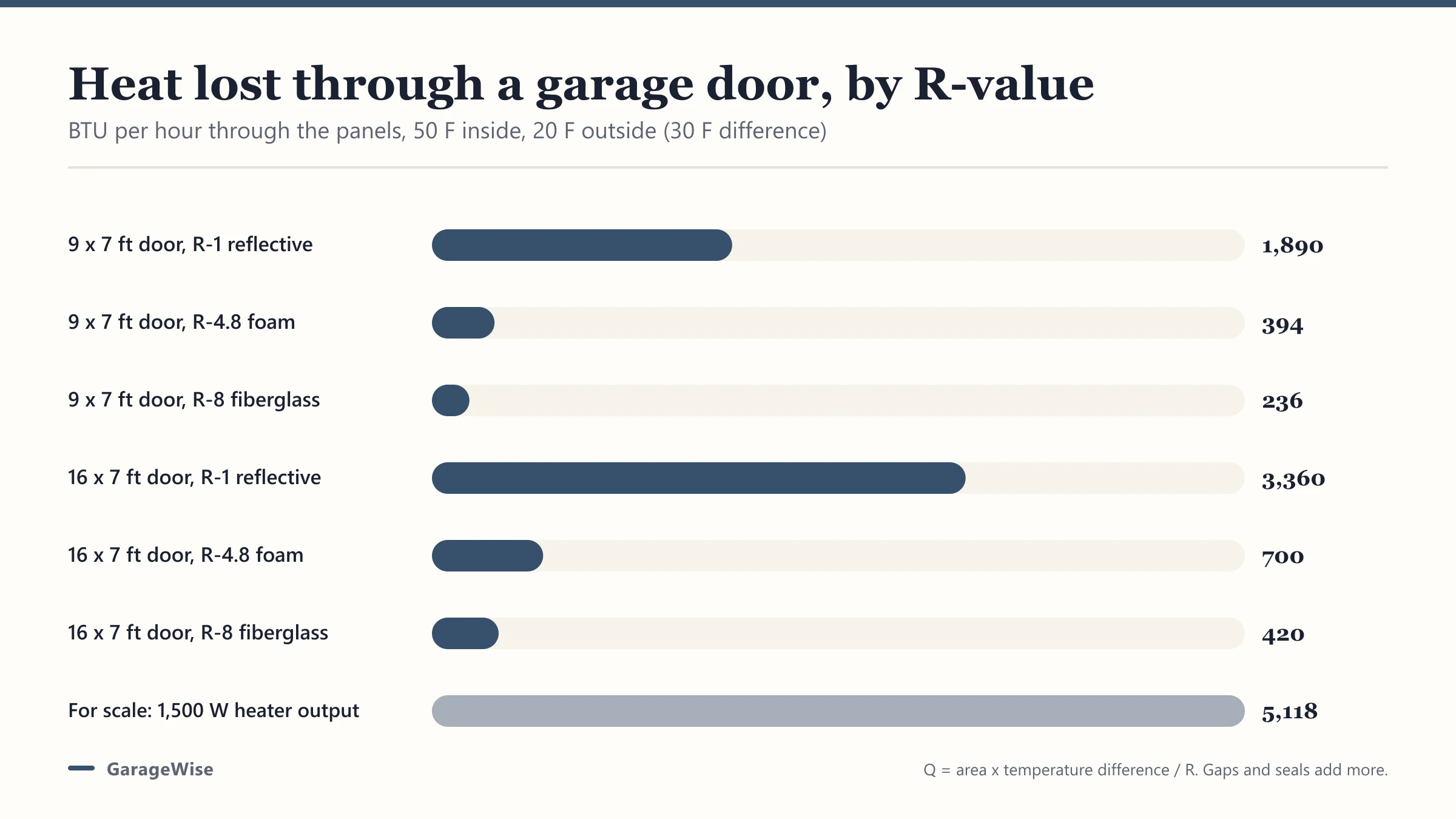
Heat flow through a panel is area times temperature difference divided by R-value. With 50 F inside, 20 F outside (a 30 F difference) and panel centers only:
| Door | R-1 (reflective) | R-4.8 (foam board) | R-8 (fiberglass) |
|---|---|---|---|
| Single, 9 x 7 ft (63 sq ft) | 1,890 BTU/h | 394 BTU/h | 236 BTU/h |
| Double, 16 x 7 ft (112 sq ft) | 3,360 BTU/h | 700 BTU/h | 420 BTU/h |
For scale, a 1,500 W plug-in heater delivers about 5,118 BTU/h (1 W = 3.412 BTU/h). Going from R-1 to R-4.8 on a single door saves about 1,500 BTU/h, close to a third of that heater. Going from R-4.8 to R-8 saves about 160 BTU/h. Real doors lose extra heat through steel stiles, gaps and seals, so treat these as best-case panel numbers. Heater sizing is in the garage heater guide.
Will a kit fit your garage door?
A kit fits when the door is single-layer steel with recessed panels framed by steel channels. That is the “pan” door most uninsulated garages have. Check these before ordering:
| Door type | Kit fit |
|---|---|
| Single-layer steel, raised or recessed panels | All five kits; panels press or clip into each recess |
| Flat (flush) steel | Reflective rolls or panels taped flat; rigid boards have nothing to hold them |
| Steel already insulated (two- or three-layer) | Skip the kit; there is no open back to fill |
| Wood or wood composite | Ask the door maker first; these kits are designed for steel doors |
| Roll-up sheet door | Only flexible products made for roll-up doors, such as BlueTex’s roll-up kit |
Count panels: a 7 ft door usually has four sections, an 8 ft door five. Door sizes by garage are listed on the garage dimensions page.
What can a garage door insulation kit not fix?
A kit insulates the door panels only. It does not seal the gap under the door, the sides, or the header, and those gaps often lose more heat than the panels. Replace a cracked bottom seal and worn perimeter weatherstrip in the same weekend. Our garage door weather stripping guide shows how to match a new bottom seal to the door’s retainer.
It also does nothing for uninsulated walls and ceilings, which together are several times the door’s area in most garages. If the goal is a heated workshop, insulate the walls and ceiling too, then size a heater for the result.
A kit is also not a substitute for a factory-insulated door. Doors built with an insulated core are rated by their maker, as our insulated garage doors guide explains, and replacing the door is a garage door installer’s job, priced in our garage door replacement cost guide.
Does insulation change how the door and opener work?
It adds weight to every section, so check the balance afterwards. Pull the opener’s release, lift the door halfway by hand and let go: a balanced door stays put, an unbalanced one drifts up or down. If it drifts, have a garage door professional adjust the springs. Spring and cable work is not a DIY job, and GarageWise does not cover it.
Do not raise the opener’s force setting to push a heavier door; that setting is part of the opener’s safety reversal. If you plan to change openers anyway, a wall-mount garage door opener frees the ceiling for overhead storage racks, but it needs a balanced door just as much.
Where do these numbers come from?
- Owens Corning Garage Door Insulation Kit: owenscorning.com product page (R-8 per ASTM C177, 2.25 in., 22 x 54 in. openings, door up to 9 ft x 7 ft 4 in, ASTM E84 40/30), read October 2026.
- Cellofoam Garage Door Insulation Kit: cellofoam.com product page (R-4.6 at 75 F, R-5.0 at 40 F, ASTM C578 Type I, 8 sheets, 60 sq ft), read October 2026.
- Matador SGDIK001 R-4.8 and panel size: Bob Vila, best garage door insulation kits, updated September 9, 2025.
- Reach Barrier 3009: reachbarrier.com product page and price, read October 2026. BlueTex 2mm Pro Residential kit: bluetexinsulation.com (about R-1, 97% radiant claim, sizes and prices), read October 2026.
- FTC R-value Rule: 16 CFR Part 460, section 460.5, eCFR, read October 2026.
- Amazon prices: listings seen October 6, 2026. Prices move often.
- Heat-flow table: Q = area x temperature difference / R, our calculation; heater conversion 1 W = 3.412 BTU/h.
Frequently asked questions
Quick answers to what readers ask us most
What is the best garage door insulation kit?
For an uninsulated steel pan door in a cold climate, the Owens Corning Garage Door Insulation Kit has the highest maker-stated rating: R-8, tested to ASTM C177, in eight vinyl-faced fiberglass panels. Foam board kits (about R-4.6 to R-5) are the cleaner, easier-to-cut alternative.
Do reflective garage door insulation kits really reach R-8?
Not by themselves. BlueTex rates its own 2 mm foil-and-foam kit at about R-1 and calls R-12 to R-15 claims deceptive. Under the FTC R-value Rule, a reflective product's material R-value is tested without air spaces; higher numbers describe a whole assembly with an air gap.
How many kits do I need for a double garage door?
Usually two single-door kits. The Owens Corning kit covers one door up to 9 ft wide by 7 ft 4 in high, and the Cellofoam kit covers about 60 sq ft. A 16x7 door is 112 sq ft. BlueTex and some reflective brands sell double-door sizes directly.
Will insulating my garage door affect the springs or opener?
It adds some weight, so check the door's balance afterwards: with the opener disconnected, a balanced door stays put when lifted halfway. If it drifts, have a garage door professional adjust the springs. Never raise the opener's force setting to make up for an unbalanced door.
Is insulating the garage door worth it if the walls are not insulated?
It helps most when the garage is heated or the door faces strong sun, and less when the walls and ceiling leak heat. Fix the bottom seal and side weatherstrip at the same time, since gaps can lose more heat than the door panels.