
Garage Door Weather Stripping: Bottom, Threshold, Side Seals
Garage door weather stripping: bottom seal types by retainer (T-end, bead, bulb, J), threshold seals, top-and-side stop molding, fit checks and 2026 prices.
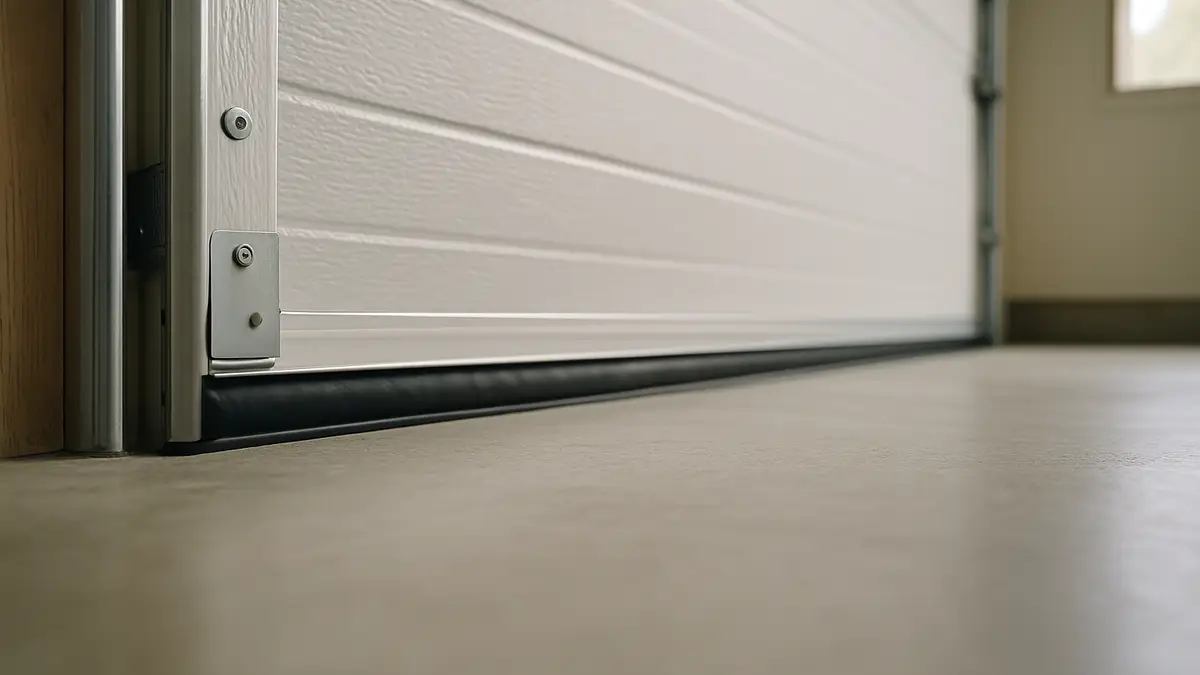
Garage door weather stripping is the set of seals around a closed garage door: one on the bottom edge, often one on the floor, and a strip on the top and both sides of the frame. Each closes a different gap, and the bottom seal only works if it matches the retainer already on your door. Products and prices below are from the makers’ own pages, checked in October 2026.
Which seal closes which gap on a garage door?
Four seals do four jobs. Most draft and water problems come from the bottom, so start there.
| Seal | Where it goes | Gap it closes | Who fits it |
|---|---|---|---|
| Bottom seal | Slides into the aluminum retainer on the door’s bottom edge | Door to floor | DIY if the retainer is intact |
| Threshold seal | Glued to the floor under the closed door | Sloped or uneven slab, wind-driven water | DIY |
| Top-and-side stop molding | Nailed to the jambs and header, flap against the door face | Door to frame | DIY |
| Section joint seals | Built into the joints between door sections | Between panels | Factory only; part of the door |
Section joints are part of the door’s design. Clopay, for example, uses tongue-and-groove joints on its insulated doors, and the door in the Cost vs. Value report’s garage door project has thermal seals between sections. They cannot be added later; that choice is made when buying a door, as covered in our insulated garage door comparison.
What types of garage door bottom seals are there?
Bottom seals are named for two things: the shape of the edge that slides into the retainer, and the shape that touches the floor. Angi’s May 2026 guide lists six common types:
| Type | How it attaches | Best for |
|---|---|---|
| T-style (T-end) | T-shaped edges slide into a single or double channel | Smooth, level floors; the most common residential seal |
| Bead-end | Round bead edge slides into a matching channel | Same doors, different retainer profile |
| Bulb (including P-bulb) | Slides in, sticks on or pushes in; a hollow bulb compresses | Uneven floors with small dips |
| J-type | Long leg on the door, curved flap on the floor | Heavy-use doors, mostly commercial |
| Nail-on or screw-on strip | Fastened straight to the bottom of the door | Wood doors and doors with no retainer |
| Brush | Bristle strip screwed to the bottom edge | Dust, leaves and insects; weak against heavy rain |
Bulb seals wear faster because they compress every time the door closes, and they cannot fill a large dip. For a big gap or a slab that slopes inward, pair a bottom seal with a threshold.
How do you identify your garage door bottom seal?
Look at the end of the old seal. Action Industries, a garage door parts supplier, gives the check in order:
- Attachment profile: does the edge that slides in look like a T, a round bead, a P or something else?
- Track configuration: one channel in the retainer or two parallel channels?
- Attachment size: measure the part that fits into the channel; the same profile comes in several sizes.
- Door width: measure the door itself, since an old seal shrinks and deforms.
- Retainer condition: straight, secure and reusable, or bent and corroded?
If the profile matches none of the common types, buy a seal made for your door’s maker or replace seal and retainer together. A bent or corroded retainer is fastened at the bottom corners next to the bottom brackets, so that is a door professional’s job.
Which bottom seals, thresholds and side seals are worth buying?
The table uses M-D Building Products’ prices from its own store and published dimensions, seen in October 2026.
| Product | Type | Size | Price seen Oct 2026 |
|---|---|---|---|
| M-D PLATINUM replacement bottom seal | Slide-in vinyl for an existing aluminum retainer, rated flexible to -50 F | 9 ft (single) or 18 ft (double) | $27.99 (9 ft), $27.91 (18 ft) |
| M-D black rubber bottom seal | Nail-on or screw-on, nails included | 9 ft or 16 ft; 2 in. wide, 1 in. tall | $11.53 (9 ft), $18.88 (16 ft) |
| M-D vinyl threshold kit | Floor threshold, adhesive included | 10 ft or 20 ft; 3-1/2 in. wide, 1/2 in. tall | $39.35 (10 ft), $64.16 (20 ft) |
| Tsunami Seal threshold kit | Floor threshold, Liquid Nails Ultra Duty Poly adhesive included | 10 ft 3 in. or 20 ft 4 in.; 1/2 in. tall | Varies by retailer; not quoted |
| M-D vinyl top-and-sides seal | Stop molding with vinyl flap, nailed to the jamb | 7 ft, 9 ft, or 30 ft roll | $9.94 (7 ft), $18.99 (9 ft), $24.76 (30 ft) |
The PLATINUM seal’s name ties it to M-D’s PLATINUM and FLEX ALLOY lines, and M-D says it slides into the existing aluminum track, so compare its profile with your retainer before ordering. The M-D threshold cuts to length with a hacksaw.
How much does it cost to seal a garage door?
About $53 to $92 for a single door and $53 to $117 for a double, in parts, using the M-D prices above. Top and sides need door height times two plus door width: 23 ft for a 9 x 7 door, 30 ft for a 16 x 7.
| Set | Single 9 x 7 ft | Double 16 x 7 ft |
|---|---|---|
| Bottom seal (PLATINUM) | $27.99 (9 ft) | $27.91 (18 ft) |
| Top and sides | $24.76 (30 ft roll) | $24.76 (30 ft roll, no spare) |
| Bottom plus top and sides | $52.75 | $52.67 |
| Threshold, if needed | $39.35 (10 ft) | $64.16 (20 ft) |
| Full set with threshold | $92.10 | $116.83 |
For a double door, a second short length of stop molding gives some margin for mistakes. A garage door company charges a service call on top of parts, so the bottom seal is the cheapest DIY fix on the door.
When does a garage door need a threshold seal?
When water or wind gets under the door even with a good bottom seal: a driveway sloping toward the garage, a slab with a dip at the door line, or blowing snow and leaves. Both M-D and Tsunami Seal thresholds add a 1/2 in. raised strip that the door closes onto.
Three cautions apply. The strip is glued to a clean, dry slab, so remove old coatings or debris first. Cars drive over it, and Angi notes vehicles can damage it. And it changes where the door stops: after installing one, run the opener’s safety reversal test. LiftMaster says the door must reverse on contact with a 1-1/2 in. object (or a 2x4 laid flat) on the floor, tested monthly and after any adjustment.
Water that still gets in, or a garage that stays damp, is a humidity problem as much as a seal problem; see our garage dehumidifier guide.
How do top-and-side seals go on?
Vinyl stop molding nails to the door jambs and header with its flexible flap facing the door. Close the door, hold the strip so the flap touches the door face lightly, and nail it in place. M-D’s instructions say to cut it to length with a hacksaw first.
Set it too tight and the door drags on the flap as it opens; too loose and daylight shows. On an older door with misaligned tracks, Raynor notes perimeter seals may not seal well, which points to track work for a door professional rather than a thicker seal.
Where is the line between DIY and a pro?
Sliding a new seal into an intact retainer, gluing a threshold and nailing stop molding are DIY jobs. The bottom brackets are not. They sit at the door’s lower corners and hold the lift cables, which carry the springs’ tension. Clopay’s brochure says its Safe-T-Bracket design exists to help prevent serious injury if a bottom bracket were removed with the door closed.
So never unbolt a bottom bracket, and leave a bent retainer, damaged bottom section, cables and springs to a garage door professional. GarageWise does not cover spring, cable or panel repair.
What can new weather stripping not fix?
Seals stop air and water at the edges; they do not insulate the door panels. A single-layer steel door still loses most of its heat through the steel, which a kit or an insulated door addresses (our garage door insulation kit guide has the numbers). If the door is old and failing anyway, a new door comes with a fresh bottom seal; prices are in our garage door replacement cost guide.
Seal first, then insulate, then size a heater: the garage heater guide assumes a sealed door.
Where do these numbers come from?
- M-D Building Products online store (PLATINUM replacement bottom seal, black rubber bottom seal, vinyl threshold kit, vinyl top-and-sides seal: prices, sizes and instructions), read October 2026.
- Tsunami Seal threshold: retailer listings for sizes, 1/2 in. height and included adhesive (Zoro, California Car Cover), read October 2026.
- Angi, garage door bottom seal types, updated May 2, 2026. Action Industries, garage door bottom seal attachment types (profiles, track count, measuring). Raynor, garage door weather stripping guide (November 10, 2025).
- LiftMaster support article, how to test the safety reversal system (1-1/2 in. object or 2x4 laid flat, monthly and after adjustments).
- Clopay Classic Steel brochures (tongue-and-groove joints, Safe-T-Bracket statement); JLC Cost vs. Value garage door replacement project description.
- We did not install or test these seals; specs and prices are the sellers’ own.
Frequently asked questions
Quick answers to what readers ask us most
How do I know which garage door bottom seal to buy?
Slide a few inches of the old seal out of the retainer and look at its end. Note the attachment shape (T, round bead, P-bulb or another), whether the retainer has one channel or two, the size of the part that slides in, and the door width. Measure the door, not the old seal, which shrinks with age.
What is the difference between a bottom seal and a threshold seal?
A bottom seal is attached to the door and closes the gap as the door meets the floor. A threshold seal is glued to the floor and gives the door a raised strip to land on. M-D and Tsunami Seal thresholds both add a 1/2 in. barrier, which helps with water and sloped or uneven slabs.
Can I replace a garage door bottom seal myself?
Yes, if the aluminum retainer is intact: the new strip slides into the channels with no hardware. Do not unbolt the bottom brackets at the door's lower corners. They hold the lift cables under spring tension, so retainer or bracket work is a job for a garage door professional.
How often should garage door weather stripping be replaced?
When it fails, not on a schedule. Raynor lists the signs: daylight under or beside the closed door, drafts, brittle or cracked rubber, water pooling inside after rain, and dust or leaves building up faster than usual.
Do I need to adjust my opener after adding a threshold?
Check it. A threshold or a thicker seal changes where the door meets the floor. LiftMaster says the safety reversal system must be tested after any change: the door must reverse when it closes on a 1-1/2 in. object, such as a 2x4 laid flat. If it does not, adjust per the opener manual or call a pro.