
Wall-Mount Jackshaft Garage Door Openers vs Ceiling Openers
Wall-mount jackshaft garage door openers vs ceiling openers: which doors they fit, clearances needed, LiftMaster 98022 vs Chamberlain RJO101, 2026 prices.
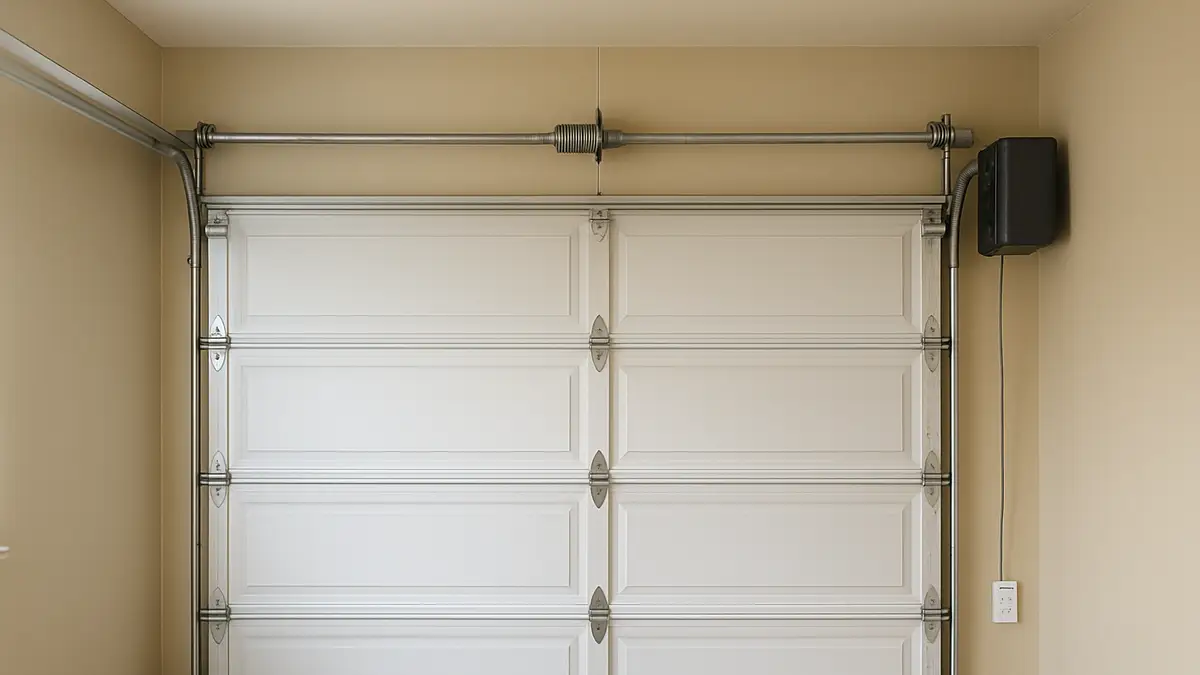
A wall-mount garage door opener, also called a jackshaft or side-mount opener, bolts to the wall beside the door and turns the torsion bar directly. A ceiling opener hangs a motor from the ceiling and pulls the door along a rail down the middle of the garage. The choice is mostly about what else needs the ceiling. Requirements below come from the makers’ own checklists and manuals, and prices were checked in October 2026.
What is the difference between a wall-mount and a ceiling garage door opener?
A wall-mount opener drives the door from the side, through the torsion bar that already carries the door’s springs and cable drums. A ceiling (trolley) opener pushes and pulls the top of the door with a trolley that runs along a rail from the header wall to a motor hanging from the ceiling.
That difference sets the trade-offs:
- Wall-mount (jackshaft): nothing hangs in the middle of the ceiling; works with high-lift tracks; needs torsion springs, a suitable torsion bar and room beside the door; costs more.
- Ceiling (trolley): works with most residential sectional doors, including many with extension springs; cheaper; the rail and motor take the center of the ceiling for about 10 ft or more back from the door.
How do the LiftMaster 98022 and Chamberlain RJO101 compare?
Both are made by The Chamberlain Group, both carry battery backup and Wi-Fi, and they differ mainly in who installs them and how heavy a door they lift. A typical ceiling belt drive from the same maker is included for scale.
| Chamberlain RJO101 | LiftMaster 98022 | Ceiling belt drive (Chamberlain B4613T) | |
|---|---|---|---|
| Mount | Wall, on torsion bar | Wall, on torsion bar | Ceiling rail and hanging motor |
| Sold for | Owner installation (retail) | Trained door technicians only | Owner installation |
| Max door height | 14 ft standard sectional | 14 ft | 7 ft rail standard; 8 ft with 8808CB-P kit |
| Max door width | 18 ft (180 sq ft) | 18 ft | See the opener manual |
| High-lift track | Up to 54 in. of high lift | Supported (8 in. drum profile) | See the opener manual |
| Max door weight | Not on the checklist | 850 lb | See the opener manual |
| Battery backup | Yes | Yes, up to 24 hours of operation | Yes |
| Power | 120 V outlet within a 6 ft diameter | 120 V, 1.5 A, 6 ft cord | 120 V outlet |
| Price seen Oct 2026 | $579 (Home Depot) | About $655 to $730 (online dealers) | About $350 to $375 (retailers) |
The 98022 box also includes an automatic garage door lock (841LM), a 1,500 lumen remote LED light and a Smart Control Panel, and LiftMaster lists a lifetime motor, 5-year parts and 1-year battery warranty.
Which garage doors can use a wall-mount opener?
A sectional door with torsion springs on a torsion bar above the opening, in good balance. Chamberlain’s RJO101 pre-purchase checklist spells it out, and says every item must be met or you need a different opener:
| Requirement (Chamberlain RJO101) | Figure |
|---|---|
| Torsion bar diameter | 1 in. |
| Torsion bar past the bearing plate | At least 1.5 in., undamaged |
| Ceiling to center of torsion bar | 3 in. or more |
| Header wall to center of torsion bar | 2.5 in. or more |
| Side wall or obstruction to end of torsion bar | 8.5 in. or more |
| Drum diameter | 4 to 6 in. (3 to 3.9 in. drums only on doors up to 430 lb) |
| Gap under the closed door | 1/4 in. or less |
| Outlet | 120 V, within a 6 ft diameter of the opener |
Extension springs, the long springs that run beside the horizontal tracks, are not compatible. LiftMaster adds that the 98022 is not intended for low-headroom tracks with outside pickup drums. Converting a door from extension to torsion springs, or changing its track, is spring and track work for a garage door professional.
How much ceiling space does a ceiling opener take?
More than most people expect. Chamberlain’s installed-length table puts a chain or belt opener at 124 in. overall (10 ft 4 in.) for a 7 ft door, 136 in. for an 8 ft door and 166 in. for a 10 ft door, measured back from the header wall down the center of the door.
Height matters as much as length. Chamberlain’s belt-drive manual sets the header bracket 2 in. above the highest point of door travel for a sectional door, and the rail runs back from there. In a garage with an 8 ft ceiling and a 7 ft door, the rail, the motor and the open door all share the top foot or so of space.
Our garage dimensions page lists door sizes and the headroom, side room and backroom a door needs, so you can see how much ceiling is left.
Why do car lift owners switch to wall-mount openers?
Because the opener rail and motor are often the lowest thing above the lift. A raised car on a 4-post or a 2-post lift needs clear height all the way to the ceiling, and a trolley opener puts a motor and rail right in the middle of the bay. Removing them can add several inches of usable lift height.
The open door is the second obstruction. A wall-mount opener leaves it in place, and only a high-lift or vertical-lift track (a door professional’s job) moves the open door up the wall and out of the lift zone. Both openers here support high-lift doors: the RJO101 up to 54 in. of high lift, the 98022 through its 8 in. drum profile for high-lift and vertical doors.
Enter the opener, the open door and the ceiling in the lift fit checker to see which one limits the lift. The home car lift guide covers the rest of the fit check, and the 2-post vs 4-post comparison shows ceiling needs per lift.
Does a wall-mount opener help with overhead storage?
Yes, it frees the center strip of the ceiling that a trolley opener uses, about 10 ft 4 in. long for a 7 ft door. That strip can then hold a light, a fan or part of a storage rack, as long as the rack stays out of the open door’s own path. Fixture counts and placement around the door and opener are in our garage lights guide.
The open door still needs its zone: roughly the door height plus 18 in. back from the header wall, across the door’s width, close to the ceiling. Our overhead garage storage guide maps where racks can go with and without a ceiling opener.
Who should not buy a wall-mount opener?
Skip it if any of these apply:
- Extension springs. The opener needs torsion springs, and a spring conversion adds a door professional’s bill on top of the opener price.
- No side room. Less than 8.5 in. between the end of the torsion bar and the side wall (RJO101) means it will not fit.
- Empty ceiling that will stay empty. If there is no lift, rack or high-lift door in the plan, a ceiling belt drive at roughly $350 to $375 does the same job.
- One-piece or non-sectional doors. Both openers are made for sectional doors only.
Whatever you choose, the door has to be balanced before the opener goes on: LiftMaster’s manual says all repairs to cables and spring assemblies must be made by a trained door systems technician first. Unit prices, labor and extras for both types are in our garage door opener installation cost guide.
Where do these numbers come from?
- Chamberlain RJO101: Chamberlain pre-purchase checklist (RET581862, 2023) hosted by Home Depot; price from the Home Depot product listing, October 2026.
- LiftMaster 98022: LiftMaster product guide (LMGDENPG98022, April 2023) for door limits, power, lift capacity, included accessories and warranty; LiftMaster 98022 owner’s manual for the technician-only installation statement, low-headroom and extension-spring exclusions, drum profiles and 24-hour battery figure; dealer prices from online garage door dealers, October 2026.
- Ceiling opener length: Chamberlain support article on installed opener lengths. Header bracket height: Chamberlain belt-drive opener installation manual (B2202, B2212T, B2405, B4505T). B4613T rail and extension kit: Chamberlain and retailer listings, October 2026.
- We did not install or test these openers; figures are the makers’ own.
Frequently asked questions
Quick answers to what readers ask us most
Do wall-mount garage door openers work with any door?
No. They need a sectional door with torsion springs on a torsion bar above the door. Chamberlain's RJO101 checklist requires a 1 in. torsion bar and 4 to 6 in. drums and rules out extension springs. LiftMaster says the 98022 is not for low-headroom tracks with outside pickup drums.
How much side clearance does a jackshaft opener need?
For the Chamberlain RJO101, at least 8.5 in. between the side wall (or any obstruction) and the end of the torsion bar, plus 3 in. from the ceiling and 2.5 in. from the header wall to the bar's center. The torsion bar must also extend 1.5 in. past its bearing plate.
Is a wall-mount opener worth it?
It is worth it when you need the ceiling: for a car lift, overhead storage racks, a high-lift door conversion, or a ceiling fan or light in the middle of the bay. If the ceiling is empty and staying that way, a ceiling belt-drive opener does the same job for less.
Can I install a wall-mount garage door opener myself?
Chamberlain sells the RJO101 for owner installation if every checklist item is met. LiftMaster states the 98022 is for installation by trained garage door technicians only. Spring, cable and track changes are always a job for a door professional.
Are wall-mount openers quieter than ceiling openers?
Both makers market them as ultra-quiet, because the motor drives the torsion bar directly and no rail or chain runs across the ceiling to carry vibration into the house. We have not measured noise ourselves, so treat that as the makers' claim.