
Types of Car Lifts Explained: Which Fits Your Garage
The main types of car lifts for a home garage compared: low-rise, mid-rise scissor, two-post, four-post and parking lifts, with ceiling, job and price for each.
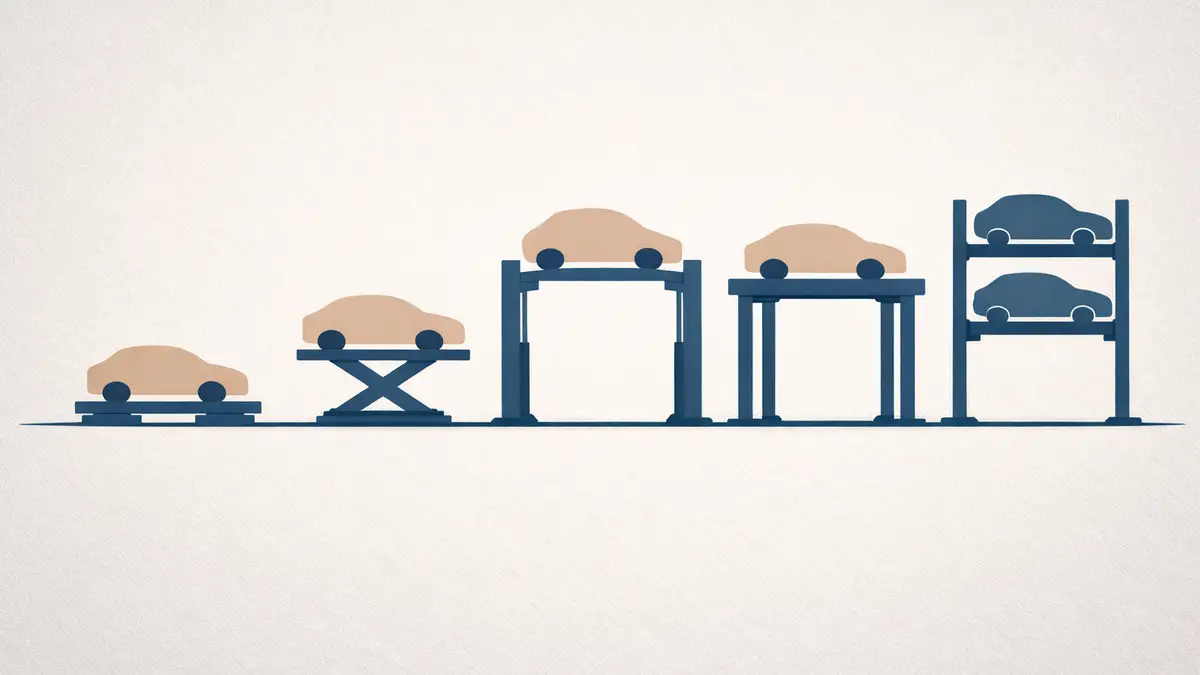
Five car lift types are sold for home garages, and the differences come down to how the lift raises the car, how much ceiling it needs, and whether it bolts to the floor. The quick split is between portable lifts, which raise a car 2 to 4 ft under an ordinary ceiling, and full-rise lifts, which let you stand under the car but need 9 to 12 ft of clear height. This guide ranks the types by the job each does best.
What are the main types of car lifts?
Home garages use five types. Here they are with how each lifts the car, the ceiling it needs and a current example, from published specs checked October 2026:
| Type | How it lifts | Lifts the car by | Ceiling needed | Example (Oct 2026) |
|---|---|---|---|---|
| Low-rise frame | Portable, flat-storing | Frame pads, about 21 in. | Any 8 ft | QuickJack 6000TL, $1,925 |
| Mid-rise scissor | Portable scissor | Frame pads, about 42 in. | Any 8 ft | BendPak MD-6XP, $3,595 |
| Two-post | Columns, anchored | Frame pads, all wheels free | 10.5 to 12 ft | BendPak 9APF, $6,295 |
| Four-post | Runways, anchoring recommended | Tires, on runways | 9 ft park, 11 ft stand | BendPak HD-9, $6,095 |
| Parking / stacker | Four-post for storage | Tires, to park a second car | About 11 to 12 ft | Varies by brand |
In-ground lifts and alignment scissor lifts exist but are shop equipment, rarely installed at home, so this guide stays with the five above.
Which lift type is best for storage and parking a second car?
A four-post lift, because it raises a car on runways and can hold a second car underneath. The car drives up onto the runways, the lift raises it, and the bay below is free to park another vehicle or store equipment. BendPak sells the HD-9 as freestanding, but its manual strongly recommends anchoring, which means drilling the slab, and warns the lift may be less stable without anchors. An optional caster kit lets the HD-9 roll.
Parking or stacker lifts are a four-post variant tuned purely for storage, with the deck sized to hold one car above another. For the storage job, these are the right family. The tradeoff is that a car on runways is harder to do wheels-free work on, which is the two-post’s strength.
Which lift type is best for repair work?
A two-post lift, because it raises the car by its frame so all four wheels hang free. That open access is what brake, suspension, tire and exhaust work needs, and it is why two-posts dominate professional service bays. The cost is ceiling and slab: a two-post must be anchored to a sound slab, and a full-rise model needs 10.5 to 12 ft of clear height depending on whether it is a floorplate or clearfloor design.
If your ceiling or slab cannot take a full-rise two-post, a portable two-post like the MaxJax gives wheels-free access at a lower height, covered in our portable car lift guide.
Which lift type fits a low ceiling?
A low-rise frame lift or a mid-rise scissor, because nothing sits above the car. A QuickJack 6000TL raises the frame about 21 in. and stores flat against a wall, so it fits any normal 8 ft ceiling and suits tire, brake and detailing work from a stool. A mid-rise scissor such as the BendPak MD-6XP locks around 42 in. with the lift structure beside the car, not above it.
Neither lets you stand fully under the car, which is the honest limit of a low ceiling. For a by-ceiling breakdown of what each height buys, see our car lift ceiling height guide, or run your numbers in the fit checker.
How do you choose the right car lift type?
Start from the job you do most, then filter by ceiling and slab. This decision order matches how most home buyers should think:
- Mostly storage, or parking a second car: four-post. Plan to anchor it, and allow about 9 ft to park under and 11 ft to stand under.
- Mostly repairs, wheels-free: two-post, if you have 10.5 to 12 ft of ceiling and a sound slab. Otherwise a portable two-post.
- Tight 8 ft ceiling: low-rise frame (QuickJack) or mid-rise scissor.
- Both storage and repairs, tall garage: a four-post with an optional rolling bridge jack, or a two-post plus a floor jack.
Width and depth matter too. A two-post needs room for the columns outside the car, so check your bay against our home car lift guide and confirm the slab in our concrete slab guide before buying.
What car lift types are rare in home garages?
Three types show up in professional shops but seldom at home. In-ground lifts mount their cylinders below the slab, so the bay is completely clear, but installing one means excavating concrete and is impractical to retrofit into an existing home garage. Alignment scissor lifts are long drive-on platforms built for wheel alignment, more lift than a home needs. Heavy-duty parking stackers raise two or more cars for dealership-style storage and demand both ceiling height and a serious slab.
A fourth distinction sits inside the two-post family: symmetric versus asymmetric. A symmetric lift places the columns directly across from each other and splits the car evenly between them. An asymmetric lift rotates the columns and sets the arms so the car sits back, which frees up door-opening room. Most home two-posts sold today are asymmetric or versatile for exactly that reason.
How much do the car lift types cost?
Portable lifts run cheapest and full-rise lifts the most, with two-post and four-post close in price. These were maker list prices in late 2026:
| Type | Example | List price |
|---|---|---|
| Low-rise frame | QuickJack 6000TL | $1,925 |
| Mid-rise scissor | BendPak MD-6XP | $3,595 |
| Portable 2-post | MaxJax MAX7 | $5,395 |
| 4-post storage | BendPak HD-9 | $6,095 |
| Floorplate 2-post | BendPak 9APF | $6,295 |
Freight, a 240V circuit and installation are extra on the full-rise lifts, which is why the portable 110V lifts often cost less in total for a home garage even when the sticker prices look close.
Who should not buy any car lift?
Anyone who services a car twice a year, rents the garage, or cannot meet a bolt-down lift’s slab and power needs. A low-rise portable lift avoids the slab and power hurdles, but even those cost more than ramps and jack stands, which handle occasional oil changes on a sound floor for a fraction of the price. Buy a lift when you work on cars often enough that the time and access pay for it.
Where do these numbers come from?
We did not test these lifts; the figures are the makers’ published specs and prices. Lift heights and October 2026 list prices: QuickJack specification table, BendPak product pages for the MD-6XP, HD-9 and 9APF, and maxjax.com, all checked October 2026, with QuickJack and MaxJax prices rechecked November 2026. HD-9 anchoring: HD-9 manual Rev N2, November 2023. The ceiling figures add a working margin to each lift’s tallest part, the same basis the GarageWise fit checker uses.
Frequently asked questions
Quick answers to what readers ask us most
What are the main types of car lifts?
For home garages, five: low-rise frame lifts (such as QuickJack), mid-rise scissor lifts, two-post lifts, four-post lifts, and parking or stacker lifts. Shops also use in-ground and alignment scissor lifts, but those are rare at home. The split that matters is portable lifts versus full-rise lifts you can stand under.
What is the best type of car lift for a home garage?
It depends on the job. A four-post lift is best for storage and oil changes and can often stand without anchors, though BendPak strongly recommends anchoring its HD-9. A two-post is best for brakes, suspension and tire work because the wheels hang free. Under a low ceiling, a QuickJack or mid-rise scissor is the only type that fits.
What is the difference between a two-post and four-post lift?
A two-post lifts the car by its frame so all four wheels hang free, which suits repair work, and it must be anchored. A four-post lifts the car on runways under its tires, which suits storage and parking a second car underneath, and it can stand without anchors, though BendPak strongly recommends anchoring its HD-9. Four-posts also need less ceiling to park under.
What type of car lift needs the least ceiling height?
A low-rise frame lift like the QuickJack, which raises a car about 21 in. and stores flat, so it fits any normal 8 ft ceiling. A mid-rise scissor is next. Full-rise two-post and four-post lifts need roughly 9 to 12 ft depending on the model and whether you want to stand under the car.