
Concrete Slab for a Car Lift: Thickness and PSI
How thick a concrete slab a car lift needs, the PSI and cure time makers require, anchor distances from joints, and how to test an existing garage slab first.
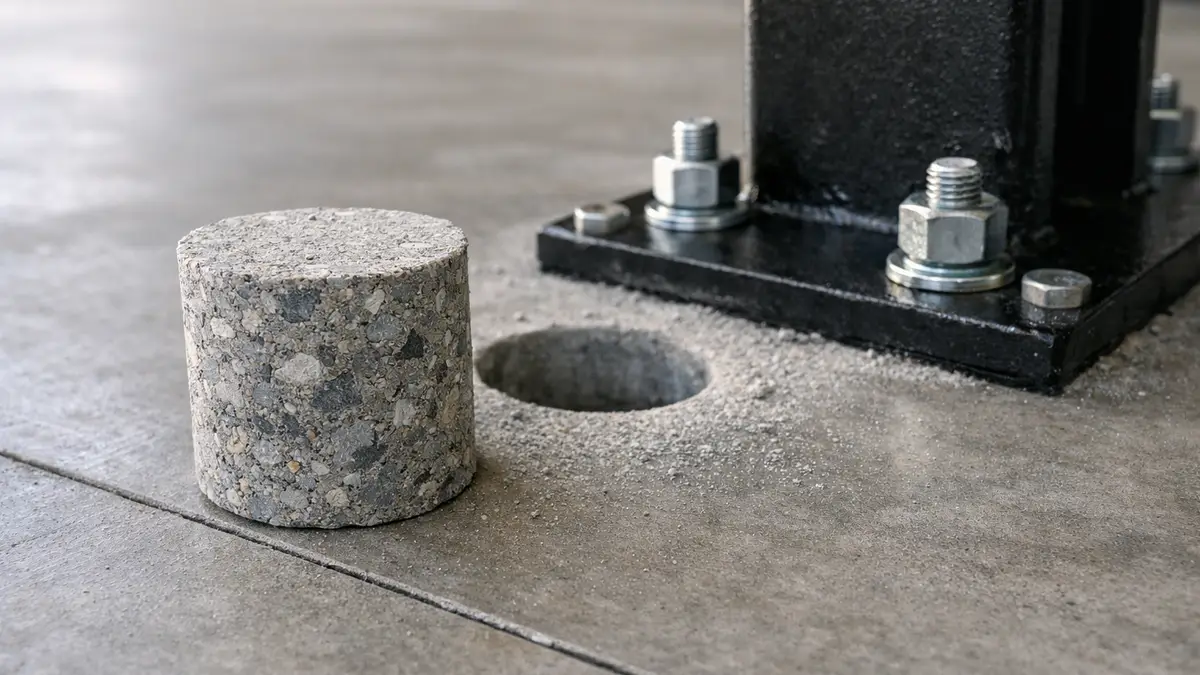
A car lift that bolts to the floor is only as safe as the slab under it. The anchors that hold a 2-post upright pull against the concrete, so the lift’s manual sets a minimum thickness, a minimum strength in psi, a cure time, and how far the anchors must sit from any joint or crack. QuickJack-style portables sidestep this because they are not anchored. A 4-post or scissor lift does not: the BendPak HD-9 and MD-6XP manuals set their own slab minimums, and the HD-9 manual strongly recommends anchors. This page collects the published requirements and how to check an existing floor.
What does a car lift need from the concrete slab?
Most bolt-down lifts share four requirements: concrete only, a minimum strength, a minimum cure time, and anchors kept away from edges and cracks. BendPak states that all of its lifts must be installed on concrete only, that existing concrete must reach at least 3,000 psi and be cured at least 28 days, that a core sample should verify strength, and that anchors must sit at least 6 in. from expansion seams, control joints and cracks. It also says never to install on hand-mixed concrete.
Here is how the common home lifts compare, from published specs checked October 2026:
| Lift | Anchored to slab? | Minimum thickness | Minimum strength |
|---|---|---|---|
| QuickJack 6000TL | No, flat floor only | Flat, hard floor | Not specified |
| BendPak MD-6XP (mid-rise) | No, does not bolt down | 4.25 in. | 3,000 psi, 28-day cure if newly poured |
| BendPak HD-9 (4-post) | Strongly recommended | 4.25 in. | 3,000 psi, 28-day cure |
| MaxJax (portable 2-post) | Yes | 4.25 in. | 3,000 psi |
| BendPak 9APF / 10AP (2-post) | Yes | Per manual, around 4.25 in.+ | 3,000 psi, 28-day cure |
The pattern is clear: most of these lifts carry real slab requirements, including the HD-9 4-post and the MD-6XP scissor lift. QuickJack-style low-rise frames are the forgiving choice for an unknown floor.
How thick does the slab need to be?
For a bolt-down 2-post, plan on at least 4.25 in. of concrete, and treat a true 4 in. slab as borderline. MaxJax lists a minimum of 4.25 in. of 3,000 psi concrete, fully cured and free of cracks and joints under the columns. BendPak directs installers to its concrete requirements and a core sample rather than assuming a slab is adequate.
The problem for existing homes is that a residential garage slab is often poured at 4 in., sometimes less at the edges, and its real strength is unknown. That is why a core test matters: the number on a spec sheet is a minimum, and your floor may or may not meet it. A 4-post lift does not avoid the question: the HD-9 manual sets the same 4.25 in. and 3,000 psi minimums.
What strength and cure time does the concrete need?
At least 3,000 psi, cured a full 28 days. Concrete gains most of its strength over 28 days, so a freshly poured slab is not ready for lift anchors even if it feels hard. BendPak requires existing concrete to reach a minimum of 3,000 psi and to be cured at least 28 days before a lift is installed, and recommends a core sample to confirm the strength rather than guessing.
If you are pouring a new slab specifically for a heavy lift, 3,500 psi and a thickness above the minimum add margin, and keeping the control joints away from the anchor pattern avoids the 6 in. setback problem before it starts.
Where can anchors go, and where can they not?
Anchors must sit at least 6 in. from any expansion seam, control joint, cold joint or crack, per BendPak. Concrete near an edge or a joint has far less holding strength, so an anchor placed too close can pull out under load. Before you commit a lift location, mark the joints and cracks and confirm the lift’s base plates can sit with every anchor at least 6 in. clear.
Two slab types stop the job cold:
- Post-tensioned slabs have steel cables under tension cast into the concrete. Drilling one without the builder’s drawings and a professional’s sign-off can sever a cable, which is dangerous and expensive. Never drill blind.
- Slabs over radiant heat tubing or conduit. Hitting embedded tubing floods or shorts the floor. If you do not know what is in the slab, scan it first.
How do you test an existing garage slab before drilling?
Confirm thickness, strength and what is embedded, in that order. Work through these steps:
- Thickness. Drill or core a small test hole at the planned anchor location, or measure at an edge, saw cut or drain. You are checking it meets the lift’s minimum, not an average.
- Strength. A concrete testing company can core a sample and report the psi. This is the step BendPak recommends and the only way to know an old slab reaches 3,000 psi.
- What is inside. Use a cover meter or GPR scan to find rebar, post-tension cables, conduit or radiant tubing before you drill anchors.
- Condition. Map cracks and joints so every anchor clears them by 6 in.
If the slab fails any of these and you still want to stand under a car, the honest options are to pour a new slab to spec or to choose a QuickJack-style lift that only needs a flat, hard floor. Our home car lift guide and the ceiling-height breakdown cover which lifts avoid anchoring.
What anchors does a car lift use, and how deep?
Bolt-down lifts use concrete wedge anchors, commonly 3/4 in. diameter, driven into holes drilled through the base plates into the slab. The manual specifies the anchor size, the hole depth, the minimum embedment and a torque value to set them to. Under-torqued anchors can work loose; a cracked or thin slab can let them pull out under load. This is why the slab strength and the 6 in. setback from joints matter as much as the thickness.
If an anchor spins or will not hold torque, stop. It usually means the concrete there is too weak, too thin, or too close to a void, and setting a lift on it is not safe. Epoxy anchors are sometimes used to salvage a marginal hole, but a slab that will not hold a standard wedge anchor is telling you the floor is not ready for the lift.
Should you pour a new slab for a car lift?
If your existing floor fails the thickness or strength test, a new slab is the honest fix for a lift you stand under. A slab poured for a heavy lift is typically thicker than the 4 in. residential minimum, at 3,500 psi or better, with reinforcement and the control joints kept clear of the anchor pattern. Give it the full 28-day cure before drilling any anchors.
This is work for a concrete contractor who knows the lift’s load, not a weekend pour. The cost can rival the lift itself, which is one more reason a QuickJack-style lift is attractive when the existing slab is unknown.
What about coating the floor under a lift?
Coat before the lift goes in, and follow the lift manual on anchoring through the coating. A thick coating or floor tile under the base plates can change how the anchors seat, so keep tiles out of the lift footprint and treat a coated area as the manufacturer directs. If you plan to finish the floor, see our garage floor coating options and schedule the coating before the lift, not after.
Where do these numbers come from?
We did not test these slabs or lifts; the requirements are the makers’ published figures. Slab rules: BendPak’s concrete floor requirements page, which states concrete-only installation, a 3,000 psi minimum, a 28-day cure, a core-sample check and the 6 in. anchor setback, and MaxJax’s concrete requirements listing 4.25 in. of 3,000 psi concrete, both checked October 2026, with the MaxJax page, which still names the M7K, re-read November 2026. HD-9 anchoring and slab minimums: HD-9 manual Rev N2, November 2023. MD-6XP floor rules: MD-6XP manual Rev F2, April 2021. The 28-day strength-gain figure is standard concrete practice. Always follow the manual for your exact lift model over any general figure here.
Frequently asked questions
Quick answers to what readers ask us most
How thick does concrete need to be for a 2-post car lift?
Most home 2-posts call for a minimum around 4.25 in. of concrete, and some ask for more. A MaxJax requires at least 4.25 in. of 3,000 psi concrete. BendPak states its lifts must be on concrete only, at least 3,000 psi, cured 28 days. A typical 4 in. residential slab is borderline, so verify yours.
Can I install a car lift on a 4-inch slab?
Sometimes, but it is the low end. A MaxJax lists 4.25 in. as its minimum, so a true 4 in. slab falls short of that model. The BendPak HD-9 4-post and MD-6XP scissor manuals ask for the same 4.25 in. of 3,000 psi concrete, while QuickJack only needs a flat, hard floor. For a bolt-down 2-post, core-test the actual thickness and strength before drilling.
What PSI concrete do I need for a car lift?
At least 3,000 psi for most home lifts. BendPak requires existing concrete to reach a minimum of 3,000 psi and be cured at least 28 days, and recommends a core sample to confirm strength. For a new slab poured for a heavy lift, 3,500 psi and extra thickness add margin.
Do 4-post and portable lifts need to be anchored?
It depends on the lift. BendPak sells the HD-9 4-post as freestanding, but its manual strongly recommends anchoring, warns the lift may be less stable without anchors and says skipping them could void ALI certification. The MD-6XP scissor lift does not bolt down, but its manual sets the same concrete minimums. QuickJack only needs a flat, hard floor, which is why it suits unknown or thinner slabs. Two-post lifts and some 4-posts must be anchored to concrete that meets the manual, with anchors set back from joints and cracks.