
2-Post vs 4-Post Car Lift: Which One Fits Your Garage
2-post vs 4-post car lift for a home garage: wheels-free access vs storage, ceiling height from BendPak specs, footprint, slab, power and October 2026 prices.
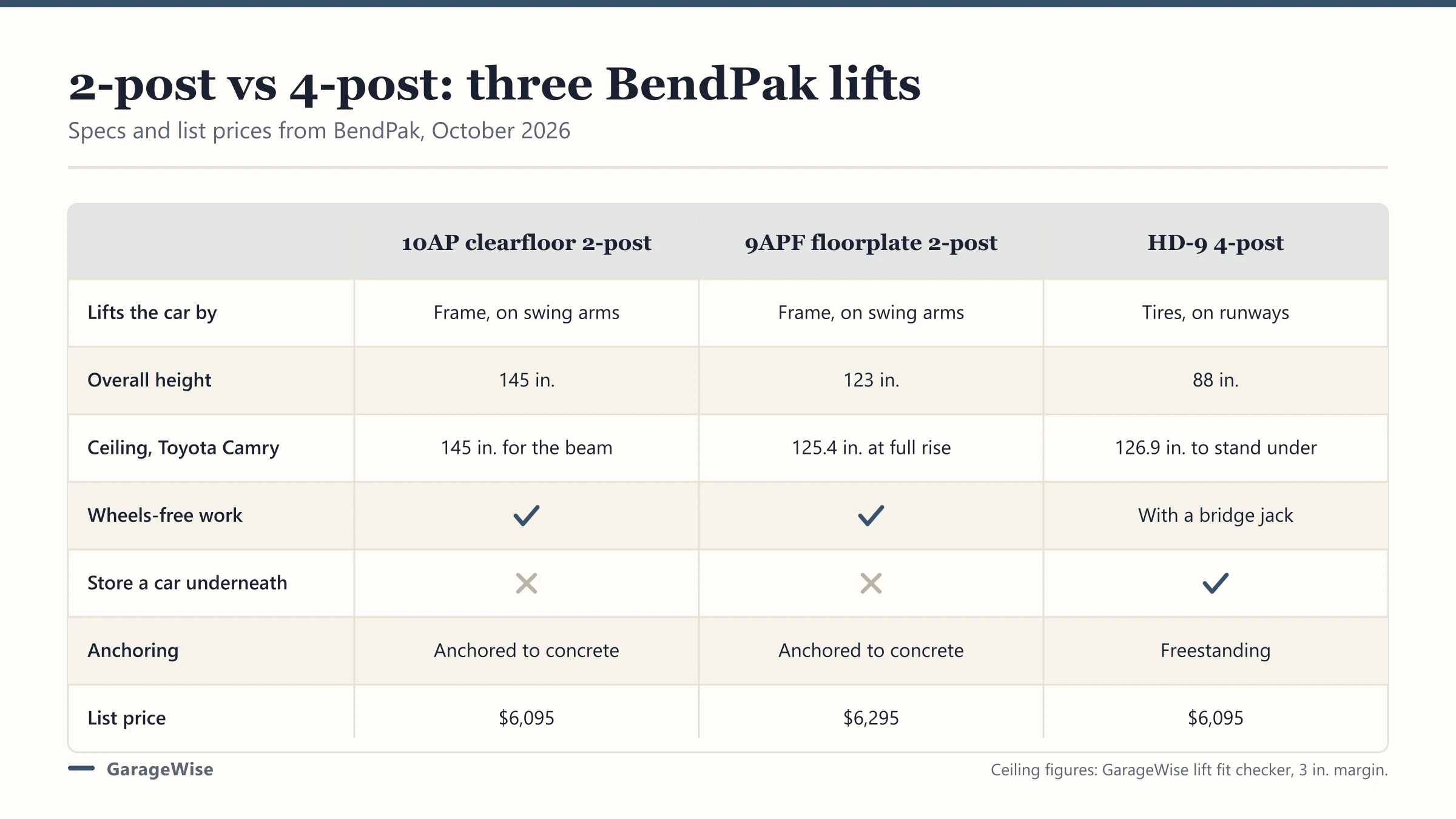
The 2-post vs 4-post choice is really a choice between two jobs: repairing the car with the wheels hanging free, or storing and servicing it on its tires. The garage then decides whether either one fits. This page compares both on published BendPak specifications, and every ceiling figure comes from the same formulas as our car lift ceiling height calculator.
What is the difference between a 2-post and a 4-post car lift?
A 2-post lift raises the car by its frame lift points on four swing arms attached to two columns, so the wheels and suspension hang free. A 4-post lift raises the car on two drive-on runways carried by four posts, so the car sits on its tires.
That difference sets everything else:
- 2-post: open access to wheels, brakes, suspension and the whole underside. Columns must be anchored into concrete. Clearfloor models have an overhead beam; floorplate models run a low plate across the floor instead.
- 4-post: drive on, lock, and park another car underneath. Many storage models can stand without anchors, but BendPak strongly recommends anchoring its HD-9. The runways cover part of the underside, and wheels-free work needs a bridge jack.
How do popular 2-post and 4-post lifts compare?
The table compares three BendPak lifts sold for home garages, with specifications and list prices from BendPak’s product pages in October 2026.
| BendPak 10AP | BendPak 9APF | BendPak HD-9 | |
|---|---|---|---|
| Type | 2-post clearfloor | 2-post floorplate (low ceiling) | 4-post storage and service |
| Capacity | 10,000 lb | 9,000 lb | 9,000 lb |
| Overall height | 145 in. | 123 in. | 88 in. |
| Max lifting height | 73 in. rise plus pad (82.5 in. listed maximum with pad) | 73.5 in. with pad | 75 in. runway top |
| Lowered height | 4 in. | 4.5 in. | 5 in. runways |
| Overall width | 135 to 145 in. | 136 to 146 in. | 110.25 in. |
| Length | Columns only | Columns plus 1.5 in. floorplate | 200.5 in. |
| Locks | Every 3 in. | Multiple positions | 14 positions, 4 in. apart |
| Power | 208 to 230V, 1-phase | 208 to 230V, 1-phase | 208 to 230V, 1-phase |
| Anchoring | Anchored to concrete | Anchored to concrete | Sold as freestanding; manual strongly recommends anchoring |
| List price, Oct 2026 | $6,095 | $6,295 | $6,095 |
Cheaper models sell on BendPak’s site under the APEX name: the APEX AL10C clearfloor 2-post lists at $4,195 and the AL9LC floorplate at $3,895. Among 4-posts, the space-saving HD-9ST lists at $5,995.
How much ceiling height does each lift need?
A clearfloor 2-post needs the most ceiling, a floorplate 2-post less, and a 4-post the least, but the car and the job change the answer. Lift sellers often quote rules of thumb such as 11 to 12 ft for a 2-post; the figures below come from spec-sheet math instead, with a 3 in. safety margin above the roof and a 70 in. (5 ft 10 in.) person.
| Lift and goal | Vehicle | Ceiling needed |
|---|---|---|
| 10AP, any use | Any | 145 in. (12 ft 1 in.) for the beam |
| 9APF, full rise | Toyota Camry (56.9 in.) | 125.4 in. (10 ft 5 in.) |
| 9APF, stand under the car | Toyota RAV4 (66.7 in.) | 133.6 in. (11 ft 2 in.) |
| HD-9, stand under the car | Toyota Camry | 126.9 in. (10 ft 7 in.) |
| HD-9, stand under the car | Toyota RAV4 | 136.7 in. (11 ft 5 in.) |
| HD-9, Camry over a Camry | Two Camrys | 126.9 in. (10 ft 7 in.) |
| HD-9, RAV4 over a Camry | RAV4 on top | 136.7 in. (11 ft 5 in.) |
Two details catch buyers out. The 10AP’s overhead beam spans the bay, so the garage door opener rail and the open door also have to clear 145 in. And its padded shutoff bar sits at 139.5 in.: a Toyota Tundra (78 in. tall) can only rise to the 67 in. lock before its roof reaches the bar. Run your own ceiling, opener height and car through the lift fit checker.
Which lift is better for working on the car?
A 2-post is better for repair work because the wheels, brakes and suspension hang free and nothing sits under the middle of the car. Brake jobs, tire rotations, suspension, exhaust and transmission work are all easier with the car held by its frame.
The BendPak 10AP’s arms are Bi-Metric, meaning they can be set symmetrically (car centered between the columns) or asymmetrically (car set back so the front doors open past the columns). Asymmetric loading matters in a narrow garage where you want to get in and out of the car on the lift.
A 4-post is better for fluid changes, inspections and detailing the underside, since you drive on and lift without positioning arms under the car. For wheels-free work it needs a rolling bridge jack between the runways, such as BendPak’s 4,500 lb RJ45W, and optional drip trays ($130 for a set of two) protect a car parked underneath.
Which lift is better for storing a second car?
A 4-post is the storage lift. It parks one car on the runways and a second underneath, locks at fixed heights (every 4 in. on the HD-9) and takes drip trays to protect the lower car. A 2-post holds the car by its frame on arms, so it is built for service, not for long-term parking with another vehicle below.
Storage is also where ceiling height bites hardest. Two sedans on an HD-9 need about 10 ft 7 in., and an SUV on top pushes that past 11 ft. In an 8 ft (96 in.) garage the same HD-9 can still lift a Camry to the 35 in. lock, leaving about 40 in. underneath: enough for a creeper, not for a second car. If your ceiling is 8 to 9 ft, compare portable car lifts as well.
How much floor space, slab and power do they need?
A 4-post takes floor length and a 2-post takes floor width. The HD-9 is 200.5 in. long (16 ft 9 in.) and 110.25 in. wide, so it occupies most of a bay but leaves the floor under the runways usable for parking. The 10AP is 135 to 145 in. wide (11 ft 3 in. to 12 ft 1 in.) across its columns, but the floor between them stays clear.
Slab requirements come from the lift manual, not from a rule of thumb. BendPak states that all of its lifts must be installed on concrete only, with anchors at least 6 in. from expansion seams, control joints and cracks, and recommends core sampling and strength testing for existing slabs. Both BendPak models in the table also need a 208 to 230V circuit. Follow the manual, local code and a licensed electrician for the power, and the manufacturer’s slab requirements for any anchoring. Measure the bay against our garage dimensions guide before ordering.
What should you check before buying either lift?
Check four things: ALI certification, ceiling obstructions, slab and power.
- ALI certification. In the US, ALI certification means the model meets the ANSI/ALI ALCTV lift safety standard and ANSI/UL 201. BendPak itself notes that not every model is certified; look the exact model up in the Automotive Lift Institute’s directory at autolift.org. BendPak lists the 10AP as ALI certified.
- Obstructions. A ceiling-mounted opener rail and the open door panel are usually the lowest things in the bay. A wall-mount garage door opener clears the rail, and ceiling racks compete for the same space (see overhead garage storage).
- Slab. Thickness, strength, cracks and joints, per the lift manual.
- Power. A dedicated 208 to 230V circuit installed by a licensed electrician.
Our home car lift guide covers all lift types, cost bands and the full fit check in one place.
Where do these numbers come from?
We did not install or test these lifts; figures are attributed. Lift specifications and list prices: BendPak product pages for the 10AP, 9APF and HD-9 and BendPak’s two-post and four-post category pages, checked October 2026. Slab statements: BendPak’s concrete floor requirements page. HD-9 anchoring: HD-9 manual Rev N2, November 2023. Vehicle heights and ground clearance: Toyota 2026 model-year product information sheets, as used in the GarageWise lift fit checker. Ceiling figures: the checker’s formulas with a 3 in. margin, a 70 in. person plus 2 in. of head clearance, and lift points at 8 in. or the vehicle’s ground clearance, whichever is higher.
Frequently asked questions
Quick answers to what readers ask us most
Is a 2-post or 4-post lift better for a home garage?
A 4-post suits most home garages that want storage plus oil changes: it fits under a lower ceiling and can stand without anchors, though BendPak strongly recommends anchoring its HD-9. A 2-post suits owners who do brakes, suspension and tire work and have about 12 ft of clear ceiling for a clearfloor model.
What ceiling height do I need for a 2-post lift?
It depends on the model and the car. The BendPak 10AP clearfloor stands 145 in. (12 ft 1 in.); the BendPak 9APF floorplate stands 123 in. (10 ft 3 in.), and raising a Camry to its full 73.5 in. pad height on it needs about 125.4 in.
What ceiling height do I need to park one car over another on a 4-post lift?
Add the bottom car's height, a margin, the runway thickness, the top car's height and another margin. On a BendPak HD-9 with 3 in. margins, a Camry over a Camry needs about 126.9 in. (10 ft 7 in.); a RAV4 over a Camry needs about 136.7 in. (11 ft 5 in.).
Does a 4-post lift need to be bolted down?
It should be, on the HD-9. BendPak's product page calls the HD-9 freestanding and it sells an $825 Portable Wheel Kit for moving the lift, but the HD-9 manual strongly recommends anchoring, warns the lift may be less stable without anchors and says skipping them could void ALI certification. With a rolling bridge jack it must be anchored. A 2-post lift must be anchored into concrete that meets the manufacturer's thickness and strength requirements.
Can you do wheel and brake work on a 4-post lift?
Yes, with a rolling bridge jack that lifts the car off the runways by its lift points. BendPak's RJ45W bridge jack is rated at 4,500 lb. It adds cost and takes some of the runway height.