
Garage Floor Tiles vs Mats: Interlocking Options Compared
Garage floor tiles vs roll-out mats: rigid polypropylene vs flexible PVC, vented vs solid, 2026 prices per sq ft, and when a floating floor beats a coating.
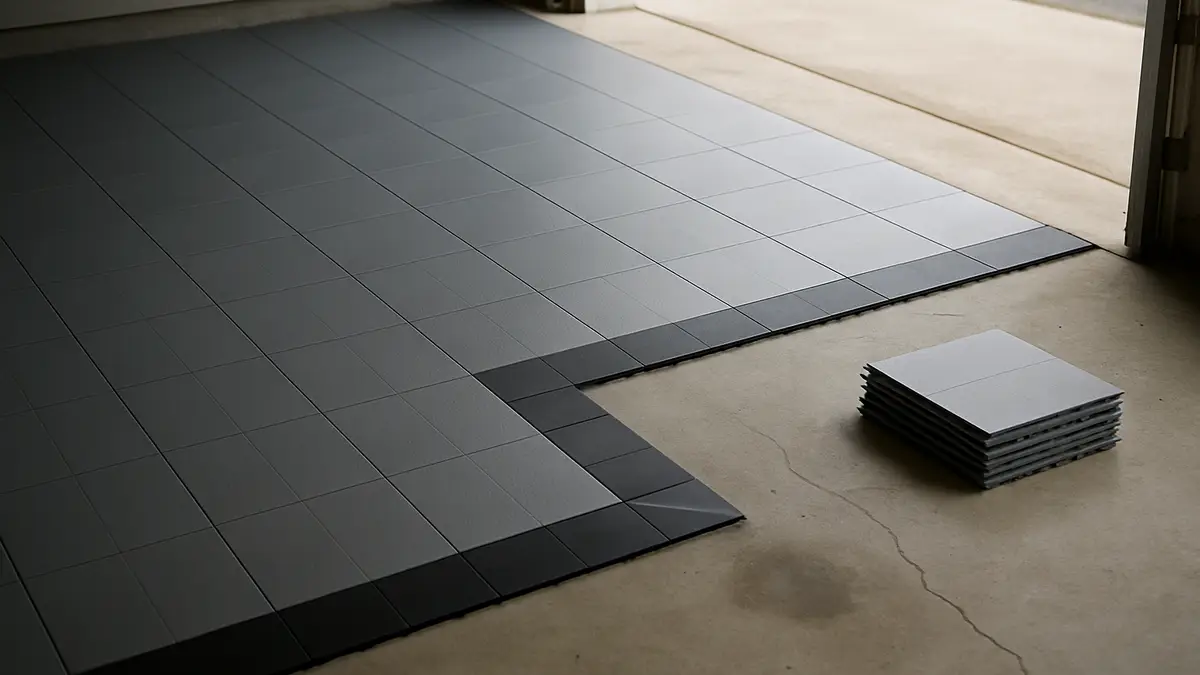
Garage floor tiles and mats are floating floors: they sit on the concrete instead of bonding to it. That one fact decides most of the comparison with epoxy, and it also explains where tiles go wrong. Prices below are from one retailer list in October 2026, so they compare like for like.
What are interlocking garage floor tiles?
Interlocking garage floor tiles are modular plastic squares, usually 12 x 12 in. polypropylene or about 20 x 20 in. PVC, that snap or lock together into a floor that rests on the slab without glue. They come in two families:
- Rigid tiles are hard polypropylene, 12 x 12 in. and about 1/2 in. thick, with a hollow underside on legs. RaceDeck, Swisstrax and TechFloor are typical. They click together and are the noisiest underfoot.
- Flexible tiles are softer PVC, larger (about 18 to 20.5 in. square) and thinner (5 to 7 mm). Coin Top Home and SupraTile are examples. They are quieter and give a little underfoot.
Manufacturers publish large load ratings, such as 80,000 lb for RaceDeck Diamond (Bob Vila, March 2025) and a 60,000 lb rollover rating for Swisstrax Ribtrax Pro. These are marketing figures, but they show that cars are not the limiting load.
What do garage floor tiles and mats cost?
Tiles run about $2.70 to $6.70 per square foot and roll-out mats about $1.70 to $2.40. These are Greatmats list prices from October 2026; RaceDeck tiles are 1 sq ft each, so the per-tile price is the per-square-foot price.
| Product | Type | Size and thickness | Price per sq ft |
|---|---|---|---|
| TechFloor Standard | Rigid polypropylene, solid | 12 x 12 in. | $2.74 |
| TechFloor Premium | Rigid polypropylene, solid | 12 x 12 in. | $3.19 |
| TurboTile Diamond | PVC, solid | 12 x 12 in., 5/8 in. | $3.28 |
| RaceDeck Free-Flow | Rigid polypropylene, vented | 12 x 12 in., 1/2 in. | $3.99 |
| TurboTile Perforated | PVC, perforated | 12 x 12 in., 5/8 in. | $4.22 |
| RaceDeck Diamond | Rigid polypropylene, solid | 12 x 12 in., 1/2 in. | $4.85 |
| Coin Top Home | Flexible PVC, solid | 20.5 x 20.5 in., 5 mm | $3.87 to $4.61 |
| SupraTile T-Joint | Flexible PVC, solid | 20 x 20 in., 6.5 mm | $5.91 |
| SupraTile Dovetail | Flexible PVC, solid | 20 x 20 in., 7 mm | $6.67 |
| G-Floor Lite Diamond roll | Vinyl roll | 7.6 x 14 ft | $1.72 |
| G-Floor Diamond Tread roll | Vinyl roll | 7.6 x 17 ft, 1.9 mm | $2.43 |
Swisstrax sells direct from $3.99 per sq ft. For context, a DIY epoxy floor costs about $2 to $5 per sq ft in materials, as our epoxy garage floor cost guide shows.
How much does it cost to tile a 2-car garage?
A 24 x 24 ft two-car garage (576 sq ft, the reference size in our garage dimensions guide) costs about $1,580 to $3,840 to tile, before edge pieces. Covering only the parking spots with mats costs a fraction of that.
| Approach | Product | Area | Cost |
|---|---|---|---|
| Full floor, budget rigid | TechFloor Standard | 576 sq ft | $1,578 |
| Full floor, mid-range rigid | RaceDeck Diamond | 576 sq ft | $2,794 |
| Full floor, vented | TurboTile Perforated | 576 sq ft | $2,431 |
| Full floor, flexible PVC | SupraTile T-Joint | 576 sq ft | $3,404 |
| Full floor, roll-out | G-Floor Diamond Tread | 576 sq ft | about $1,400 |
| Parking pads only | Two G-Floor 7.6 x 17 ft rolls | 258 sq ft | about $628 |
Add ramped edge pieces for the door threshold and any exposed edge, and expect some waste where tiles are cut around posts, drains and steps.
Should you choose vented or solid tiles?
Choose vented tiles if water comes in on the cars and solid tiles if spills should stay on top. Vented and perforated tiles let rain and snowmelt fall through to the slab, where it drains or dries in the air gap under the tile, and the walking surface stays dry. Greatmats notes that tiles with an air gap underneath let moisture evaporate as air moves below them.
Solid tiles hold oil, coolant and sawdust on the surface, where a mop or shop vacuum can reach them. With vented tiles, the same spill ends up on the concrete under the floor, and fine dust collects in the openings. One workable compromise is vented tiles in the parking bays and solid tiles in the workshop corner.
How do roll-out mats and containment mats compare with tiles?
Roll-out mats are the cheapest floating floor and the fastest to install: you unroll them, trim them and park. G-Floor rolls from Better Life Technology are 100% polyvinyl, come in widths of 5 to 10 ft and lengths up to 24 ft, range from 50 to 130 mil thick depending on texture, need no adhesive and carry a limited lifetime warranty.
There are three kinds of mat:
- Roll-out vinyl (G-Floor and similar): covers a full bay and protects the slab from oil and tire marks.
- Absorbent mats (G-Floor Drip & Dry): a fibrous top that wicks liquid over a vinyl base, for drips under a parked car.
- Containment mats: raised-edge mats that hold snowmelt and road salt water under the car until it evaporates or is squeegeed out.
Mats are a better buy than tiles when the goal is just to protect the concrete under the cars. Tiles are the better buy when you want the whole garage to look finished.
When do tiles beat a floor coating?
Tiles beat a coating when the slab is the problem or when the floor has to be reversible. Bonded coatings fail when the concrete underneath fails, and installers name moisture coming up through the slab as the number one cause of coating failures. A floating floor does not bond, so it does not peel.
Tiles are the better choice when:
- The slab has cracks, spalls or old patches you do not want to grind and repair.
- A moisture test fails, or the slab sweats in humid weather. The plastic-sheet test is in our epoxy application guide, and why slabs sweat on humid days is explained in our garage dehumidifier guide.
- You rent, or plan to move and take the floor with you.
- You need the garage back the same day; there is no cure time.
A coating is the better choice when you want one jointless surface that wipes clean, when cost per foot matters most on a sound slab, or when you work with fluids and fine dust every week. Our garage floor coating comparison puts both on one table.
Who should not use garage floor tiles?
Skip tiles where something needs solid concrete underneath. Car lifts are the main case: BendPak states that all of its lifts must be installed on concrete only, so leave the lift area bare or coated and run the tiles around it. Our home car lift guide covers the slab requirements.
Tiles are also a poor fit for:
- Jack stands and floor jacks used every week. Concentrated point loads can dent plastic tiles; use a steel or plywood plate under stands, or keep a bare work area.
- Woodworking shops. Sawdust packs into vented tiles and the joints.
- Anyone who hates noise. Rigid polypropylene tiles are the noisiest option underfoot; flexible PVC and rubber are quieter.
Where do these numbers come from?
We did not install test floors; figures are attributed. Prices, sizes and thicknesses: the Greatmats garage flooring catalog, checked October 2026. Swisstrax starting price and the Ribtrax Pro rollover rating: swisstrax.com, October 2026. RaceDeck Diamond load rating: Bob Vila’s best garage floor tiles roundup (March 27, 2025). G-Floor roll sizes, thicknesses and warranty, and Drip & Dry construction: bltllc.com, October 2026. The lift statement is from BendPak’s concrete floor requirements page. Coating failure causes: Garage Force, September 2026.
Frequently asked questions
Quick answers to what readers ask us most
Are garage floor tiles better than epoxy?
Tiles are better on a cracked or damp slab, for renters, and when you need the garage back the same day. Epoxy is better when you want a jointless, wipe-clean surface at the lowest material cost and the slab is sound and dry.
How much do garage floor tiles cost for a 2-car garage?
For a 24 x 24 ft garage (576 sq ft), about $1,580 with budget polypropylene tiles at $2.74 per sq ft, $2,790 with RaceDeck Diamond at $4.85, and $3,400 with SupraTile PVC at $5.91 (Greatmats prices, October 2026). Edge ramps cost extra.
Should garage floor tiles be vented or solid?
Vented or perforated tiles let water and snowmelt drop through to the slab and dry from below, so the top stays dry. Solid tiles keep spills on top where you can wipe them up. Pick vented for wet climates and solid for a workshop with oil and sawdust.
Can you put a car lift on garage floor tiles?
No. Lift makers require the lift to stand on concrete; BendPak states that all of its lifts must be installed on concrete only. Leave the lift area as bare or coated concrete and run the tiles around it.
Do garage floor mats work instead of tiles?
Yes, under the cars. A roll-out vinyl mat such as G-Floor costs about $1.70 to $2.40 per sq ft, needs no adhesive, and two rolls about 7.5 ft wide cover two parking spots for well under the price of tiling the whole floor.