
Garage EV Charger Install: Level 2, Circuits, Cost
How to install an EV charger in a garage: Level 1 vs Level 2, the circuit size to charging-speed math, plug vs hardwire, NEC rules and real install costs.
A garage EV charger is a dedicated circuit and a wall unit that charges an electric car faster than a wall outlet. The decisions are the same for every install: the charging level, the circuit size, whether to plug in or hardwire, and whether your panel has room. This guide works through each with the numbers, so you can tell the electrician what you want rather than the other way around.
Do you need Level 1 or Level 2 in the garage?
Level 2 for most households, Level 1 only for light daily driving. Level 1 uses an ordinary 120V outlet and the cord that comes with the car, adding about 3 to 5 miles of range per hour. Level 2 uses a 240V circuit and a wall charger, adding about 20 to 40 miles per hour and fully charging most EVs overnight.
| Level | Supply | Power | Range added per hour | Install |
|---|---|---|---|---|
| Level 1 | 120V outlet | About 1.4 kW | 3 to 5 miles | Plug into existing outlet |
| Level 2 | 240V circuit | 7.2 to 11.5 kW | 20 to 40 miles | Dedicated circuit, often an electrician |
If you drive under about 30 to 40 miles a day and can leave the car plugged in overnight, Level 1 keeps up. Anyone with a longer commute, a larger battery, or two EVs wants Level 2.
What size circuit does a garage EV charger need?
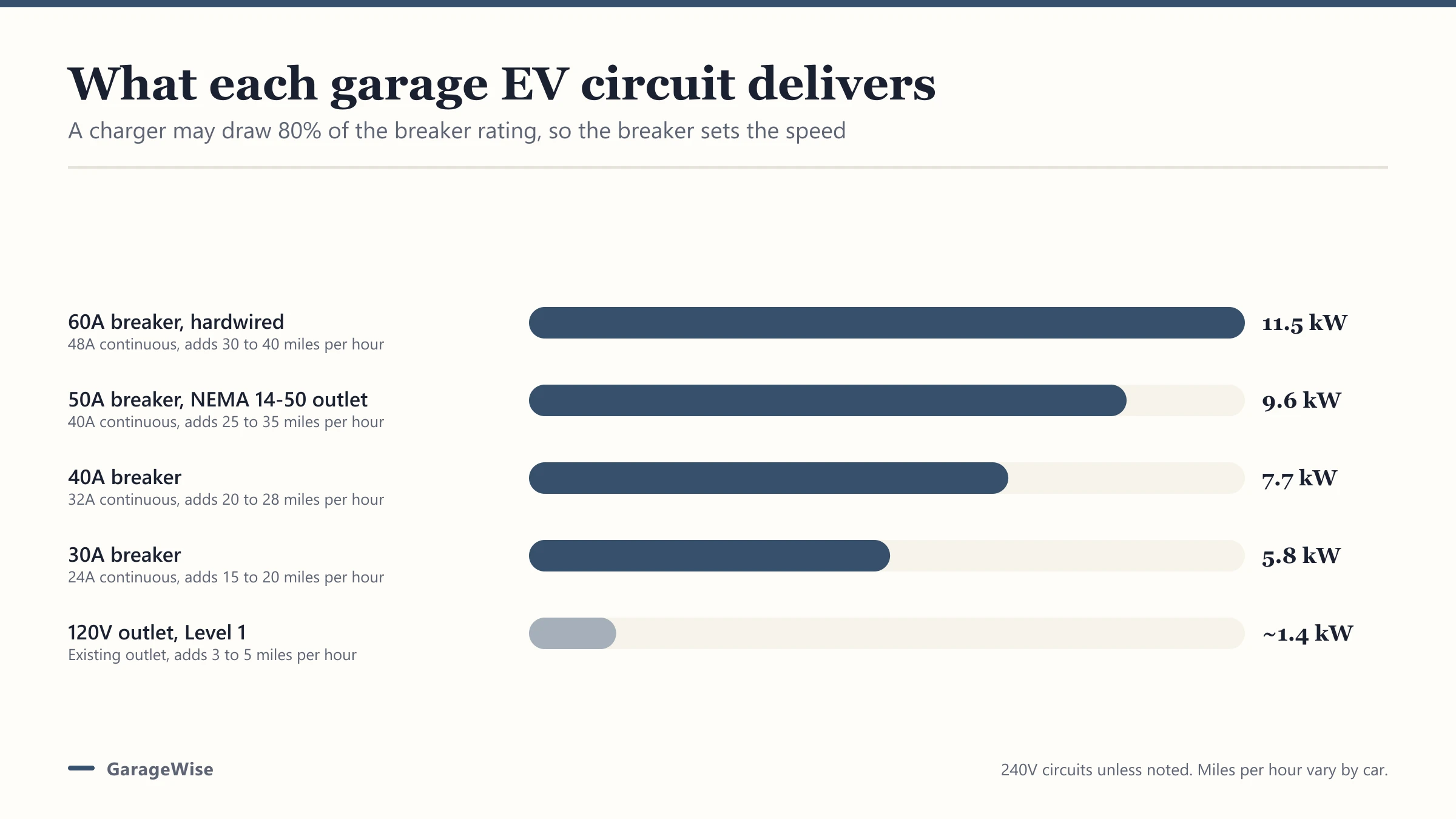
A dedicated 240V circuit, sized to the charging speed you want. The NEC counts EV charging as a continuous load, so a charger may draw at most 80 percent of the breaker rating. That rule turns breaker size directly into charging power:
| Breaker | Max continuous draw (80%) | Power at 240V | Approx. miles added per hour |
|---|---|---|---|
| 30A | 24A | 5.8 kW | 15 to 20 |
| 40A | 32A | 7.7 kW | 20 to 28 |
| 50A | 40A | 9.6 kW | 25 to 35 |
| 60A | 48A | 11.5 kW | 30 to 40 |
A NEMA 14-50 outlet sits on a 50A circuit and lets a charger pull 40A (9.6 kW), which suits most EVs. For the fastest home charging, a hardwired unit on a 60A circuit delivers 48A (11.5 kW). Miles per hour vary by the car’s efficiency.
Should you plug in or hardwire the charger?
Hardwire for a fixed, fast install; plug in if you want to move or swap the unit. A plug-in charger uses a NEMA 14-50 receptacle, so you can unplug it, take it when you move, or replace it without an electrician. A hardwired charger connects directly to the circuit, which is required for the highest-amperage units and avoids a plug as a failure point.
One cost wrinkle favors hardwiring at higher amps: the NEC now requires GFCI protection on EV-charging receptacles, and a 50A GFCI breaker is expensive. A hardwired charger with its own internal protection can skip that breaker, so for a fixed 48A unit hardwiring is often simpler and cheaper overall.
Does your garage panel have enough capacity?
Check before you buy the charger, because a full panel is the biggest cost risk. A Level 2 charger adds a large continuous load, and an electrician runs a load calculation on your existing service (often 100A or 200A) to confirm there is room. If the service is already near capacity, options are a panel upgrade, a subpanel, or a load-management device that pauses charging when the house draws heavily.
A panel or service upgrade can add $1,500 to $4,000 and is the single biggest variable in an EV charger project. Ask the electrician to do the load calculation first, so you know the real cost before committing. Running a 240V circuit for a charger is the same class of work as the circuit for a home car lift, so if you are planning both, size the panel for the pair.
Which EV chargers suit a garage?
Any UL-listed Level 2 unit rated for your circuit and, if mounted outside the garage, for outdoor use. Widely sold home units include the Tesla Wall Connector (up to 48A), ChargePoint Home Flex (up to 50A, plug or hardwire), Emporia, Grizzl-E and JuiceBox. Match three things: the amperage to your circuit, the connector (J1772 for most EVs, NACS for Tesla and newer models, with adapters common), and the cable length to reach the car’s port.
Mount the charger so the cable reaches the car’s charge port without stretching, usually on the wall near where the port sits when parked. Check your parking position against our garage dimensions guide so the cable run and the parked car both fit the bay.
How long does it take to charge an EV at home?
Divide the energy you need by the charger’s power. A Level 2 charger at 9.6 kW adds about 9.6 kWh each hour, so putting back 40 kWh, roughly 120 to 160 miles for a typical EV, takes about four hours. A full charge of a 75 kWh battery from near empty is about eight hours at 9.6 kW, which is why a Level 2 charger overnight covers almost everyone.
Level 1 at about 1.4 kW adds only 1.4 kWh per hour, so the same 40 kWh takes close to a full day. That is fine if you drive little and plug in every night, and far too slow if you run the battery low on a regular basis. The charging time you need, not the maximum the car accepts, should set the circuit size you pay for.
Do you need a permit to install a garage EV charger?
In most places, yes, for the dedicated circuit. Adding a 240V circuit, and a NEMA 14-50 receptacle if you plug in, is electrical work that local codes require a licensed electrician to permit and inspect. The permit also protects you: an inspection confirms the wire gauge, breaker and GFCI protection match a load that runs near its limit for hours at a time.
Skipping the permit risks insurance and resale problems later, so build the permit fee into the install budget rather than trying to work around it. Ask the electrician to pull it as part of the job.
Who should wait on a Level 2 install?
Renters, anyone whose panel needs a costly upgrade for light driving, and anyone parking outside reach of a circuit. If you drive little and can trickle-charge on 120V overnight, Level 1 may be all you need, and it costs nothing to install. For EV owners, good lighting at the charge point helps; see our garage lights guide, and if you heat or insulate the garage, our garage insulation guide covers keeping the space usable in winter.
Where do these numbers come from?
We did not test these chargers; the figures draw on the National Electrical Code and manufacturer ratings. The 80 percent continuous-load rule and the GFCI requirement for EV receptacles are NEC provisions (Article 625 and related sections); confirm the edition your local code uses, since adoption varies. Power figures use 240V times the continuous amperage; range-per-hour figures are approximate and depend on each EV’s efficiency. Charger amperages are the makers’ published ratings. All electrical work should be done by a licensed electrician to local code and permit.
Frequently asked questions
Quick answers to what readers ask us most
Do I need a Level 2 charger in my garage?
If you drive more than about 40 miles a day or want a full charge overnight, yes. Level 1 on a 120V outlet adds only 3 to 5 miles per hour, enough for light daily driving. Level 2 on a 240V circuit adds about 20 to 40 miles per hour and fully charges most EVs overnight.
What size circuit does a home EV charger need?
Most Level 2 chargers use a 40A or 50A dedicated 240V circuit. The NEC treats charging as a continuous load, so a charger draws at most 80 percent of the breaker: 40A on a 50A circuit (9.6 kW) or 32A on a 40A circuit (7.7 kW). Faster units hardwire to 48A or 60A breakers.
Should I plug in my EV charger or hardwire it?
Hardwire for the fastest and most permanent install, especially above 40A, and plug in (NEMA 14-50) if you want to unplug or move the charger. Receptacle installs now require GFCI protection under the NEC, which adds cost, so for a fixed 48A charger hardwiring is often simpler and cheaper.
How much does it cost to install an EV charger in a garage?
The charger is about $400 to $700, and the electrical work is roughly $300 to $1,500 depending on distance from the panel, whether the panel has spare capacity, and local permit fees. A panel upgrade, if the service is full, can add $1,500 to $4,000 and is the biggest variable.