
Air Compressor for a Garage: Size by CFM, Not Gallons
How to size an air compressor for a garage: the CFM at 90 psi each tool draws, tank size, 120V vs 240V, and quiet options, with a task-to-compressor table.
An air compressor for a garage is sized by one number most buyers ignore: the CFM at 90 psi it can deliver. Gallons get the marketing, but the tank only buffers short bursts; the pump’s CFM decides whether a tool keeps running. Pick the CFM to match your thirstiest tool, then choose a tank large enough for how long you use it, and the voltage follows from there. This guide matches tasks to the real numbers.
Why is CFM more important than tank gallons?
Because CFM is the air the pump makes continuously, and gallons are just a reserve. A tool draws a steady CFM at a given pressure; if the pump cannot keep up, the tank empties and the tool stalls until the pump catches up. A large tank on a weak pump lets you run a tool a little longer before it starves, but it does not make the compressor able to sustain a thirsty tool.
So read the CFM at 90 psi (the pressure most air tools are rated at), match it to your tools, then size the tank for run time. The gallon number matters only after the CFM is right.
How much CFM does each garage air tool need?
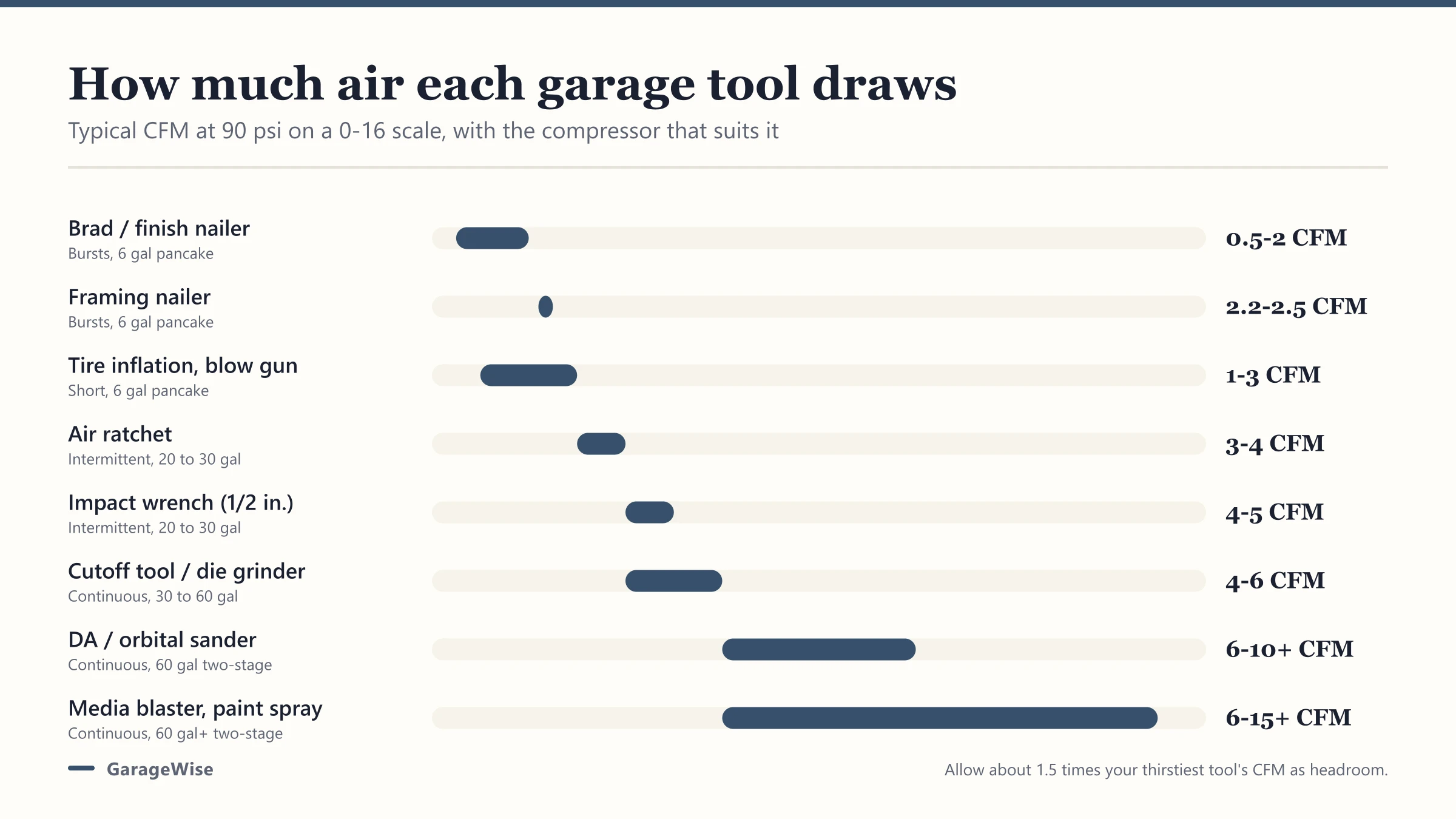
Match the compressor to your thirstiest tool, with about 1.5 times its CFM as headroom. Intermittent tools sip air; continuous tools drink it. Here are typical draws at 90 psi:
| Tool | Typical CFM at 90 psi | Use pattern | Compressor that suits it |
|---|---|---|---|
| Brad / finish nailer | 0.5 to 2 | Bursts | 6 gal pancake |
| Framing nailer | 2.2 to 2.5 | Bursts | 6 gal pancake |
| Tire inflation, blow gun | 1 to 3 | Short | 6 gal pancake |
| Air ratchet | 3 to 4 | Intermittent | 20 to 30 gal |
| Impact wrench (1/2 in.) | 4 to 5 | Intermittent | 20 to 30 gal |
| Cutoff tool / die grinder | 4 to 6 | Continuous | 30 to 60 gal |
| DA / orbital sander | 6 to 10+ | Continuous | 60 gal two-stage |
| Media blaster, paint spray | 6 to 15+ | Continuous | 60 gal+ two-stage |
The jump that catches people out is from intermittent to continuous tools. A sander or grinder runs non-stop, so it needs a pump that makes its full CFM all day, not a tank that drains in 30 seconds.
What tank size do you need?
Match the tank to how long you run tools between pauses, once the CFM is right. A small tank cycles the pump often; a large tank runs continuous tools longer before the pump must catch up:
- 6 gallon pancake: nailers, inflation, blow guns. Light, portable, 120V.
- 20 to 30 gallon: impact wrenches, ratchets, intermittent air tools. Still usually 120V.
- 60 gallon vertical stationary: continuous tools, sanders, grinders, spraying. Usually 240V and two-stage.
- 80 gallon: a full home shop that runs continuous tools daily.
A vertical 60 or 80 gallon tank takes about 2 x 2 ft of floor, so plan its spot against our garage dimensions guide and keep it off a walking path.
Do you need 120V or 240V?
Most garage compressors run on 120V; the large stationary units need 240V. A standard 120V, 15 or 20A garage circuit powers portable pancakes and most 30 gallon compressors. Above roughly 2 running horsepower, or at the 60 gallon stationary size, the motor draws more than a 120V circuit supplies and needs a dedicated 240V circuit.
If you are adding a 240V circuit anyway, plan the compressor’s spot and power with the rest of your bench setup; our garage workbench guide covers laying out the work area. For hobby use with nailers and the occasional impact wrench, a 120V compressor avoids the electrical cost entirely.
Oil-free or oil-lubricated, and how loud?
Oil-free for low maintenance and cold starts; oil-lubricated for quieter, longer-lived continuous use. Oil-free pumps are maintenance-light and common on pancake and portable units, but they run louder and wear faster under heavy duty. Oil-lubricated pumps are quieter and last longer in a shop that runs tools daily, at the cost of oil changes.
Noise is worth planning for in an attached garage:
- Standard pancake, oil-free: about 78 to 82 dB, loud enough to be unpleasant indoors.
- Quiet compressors (for example the California Air Tools range): around 70 dB, a noticeable difference.
- Reduce it further: set the unit on a rubber pad, tuck it in a corner or closet and pipe the air out, and insulate the garage, which also deadens sound. Our garage insulation guide covers that.
How should you plumb and store the compressor?
Keep a stationary compressor in a fixed spot with a short, organized air line, and store a portable one off the floor. For a stationary unit, run a hard air line (copper, aluminum, or rated pipe) to a reel or a couple of drops near the workbench, with a drain leg so moisture collects and bleeds off. A portable pancake can live on a shelf; our garage shelving and garage cabinets guides cover keeping it and its hoses off the floor.
How do you keep moisture out of the air lines?
Compressing air wrings water out of it, so a garage compressor collects condensation in the tank and pushes moisture down the line. Left alone it rusts the tank from the inside and ruins paint jobs and air tools. Drain the tank after each use through the valve underneath, and tip a portable unit so that valve sits at the low point when you open it.
For a stationary compressor feeding tools or spray equipment, add a water separator or a desiccant dryer at the outlet, and slope the hard line slightly with a drain leg at the far end so water collects where you can bleed it off rather than at the tool. A humid garage makes all of this worse, so a room dehumidifier helps the whole setup last. Inspect the tank’s drain and exterior for rust periodically, since a corroded tank under pressure is a safety issue, not just a performance one.
Who should not buy a large compressor?
Anyone whose air tools are only a nailer and a tire gauge. A 6 gallon pancake handles inflation, blow-off and nailing for a fraction of the cost, size and noise of a 60 gallon unit, and runs on any outlet. Only buy a stationary 60 to 80 gallon compressor if you run continuous air tools, sanders, grinders or spray equipment, often enough to justify the space and the 240V circuit.
Where do these numbers come from?
We did not bench-test these compressors; the figures draw on typical manufacturer tool ratings and published compressor specs. CFM-at-90-psi figures are common ranges stamped on air tools; confirm your exact tool, since models vary. Noise figures are typical published dB ratings for pancake and quiet compressors. Voltage thresholds follow standard motor practice, and any 240V circuit should be installed by a licensed electrician to local code.
Frequently asked questions
Quick answers to what readers ask us most
What size air compressor do I need for a garage?
Size it by the CFM at 90 psi your thirstiest tool needs, plus margin. Nailers run on a 6-gallon pancake (about 2 to 3 CFM). An impact wrench or ratchet wants 4 to 5 CFM and a 20 to 30 gallon tank. Continuous tools like a sander or grinder need 6 to 10+ CFM and a 60 gallon two-stage.
Is CFM or gallons more important on an air compressor?
CFM. The CFM rating at 90 psi tells you whether the compressor can keep an air tool running; the gallon tank only buffers short bursts. A big tank on a weak pump still starves a continuous tool. Match the CFM to the tool first, then pick a tank large enough for how long you run it.
Do I need a 240V air compressor in my garage?
Only for larger units. Most portable and 30-gallon compressors run on a standard 120V outlet. Above roughly 2 running horsepower or a 60-gallon stationary tank, the motor usually needs a 240V dedicated circuit. If you only use nailers and the occasional impact wrench, 120V is enough.
How do I make a garage air compressor quieter?
Buy a quiet model or isolate a loud one. Oil-free pancake compressors run around 78 to 82 dB, while quiet compressors such as the California Air Tools line run near 70 dB. You can also set the unit on a rubber pad, pipe the air from a closet or corner, and insulate the space to deaden the sound.